Tuesday, 25 May 2010

Garden beds


Gardening, always a popular hobby on these islands, has boomed in these touchy times: grow-your-own programmes seem to fill television schedules, and millions of people seem to be cleaning off the old tools in the shed and seeing what’s under their lawn. And good for them: if you have a big yard of deep soil, that’s what you should do with it.

Not everyone has such favourable conditions, however. Most people don’t live in the country, so maybe you live in a flat (apartment), maybe in a narrow row house, maybe you have only thin or contaminated soil, or only asphalt – ten percent of the arable land in the USA has now been paved over. If so, garden beds create an easy way to grow crops almost anywhere.

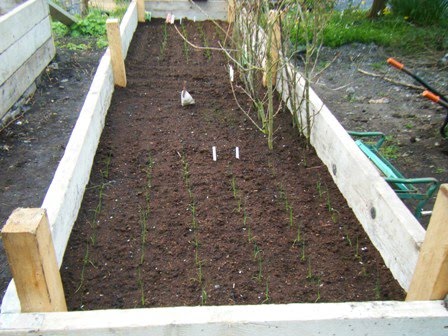
A garden bed can be as simple as a raised area in a boundary of sticks or stones, both for aesthetic reasons and to enclose the plants. We’ve built several of those in the last few weekends for our berries, herbs and salads, which don’t require deep soil. If you have asphalt or contaminated soil, or want to grow beets, however, you probably want something deeper, and that probably means either bricks with mortar or wood planks, stakes and screws. We made the latter -- metre-deep, five-metre (15 feet) long beds – over the last few weekends.

We have an acre or so of land but needed beds anyway – for reasons of geography we wanted to plant in the field in front of our new house, but that’s where my parents-in-law’s trailer used to sit, and the ground had compacted into concrete. Plan B: put the garden beds back.

We needed wood, and that’s expensive these days – to create six five-metre beds we needed 1,300 euros ($1,600) worth of wood – not even counting the stakes we needed to secure the corners, a few hundred euros more. Luckily, we found a home scaffolding business only a couple of miles away, and he had plenty of planks that no longer met safety requirements for third-floor construction but suited us just fine.

To build the beds themselves we laid scaffolding planks two long and three broad across three of the stakes -- one stake held each end, and one more held the middle. We screwed the planks into the stakes with three-inch screws, and that was one side of the garden bed. Three more planks across each end completed the bed, so heavy it took four people to lift into place. We dug the topsoil out of the space where the bed would go, placed the bed in the space, and measured every side and corner to make sure it was level – where one side was too low, we wedged rocks underneath.

The next step was to fill the bottom half of the beds, not with soil, but with sticks – in our case, sticks my father-in-law and pollarded a couple of years ago, before his passing. The sticks serve many purposes: they drain the soil in this wet climate, and allow root vegetables to grow deeply into the space below. They take up the depth into which few plants would reach, so we don’t waste manure filling the bottom half. They can help form a barrier against weeds, which will not grow vertically through wood or air pockets. Stones or gravel would also suffice.

We ran out of willows on the last bed, and used some from the cherry tree we chopped down – we eventually decided that tree rot would not affect cabbages. We also used a few from the lilandia that ring our property – but sparingly, as they are evergreens and we don’t want soil laced with turpentine. By the way, never fill your bed with live branches, especially willow -- my mother-in-law did this by mistake, and spent years clipping out shafts of willow tree that kept popping up between the carrots.

Speaking of manure, we were lucky here as well – a farmer friend of ours had some horse and cow manure, two years’ ripened so that it smelled and felt like soil rather than poo – and was willing to truck it in. For weeks we’ve been the proud owners of a two-metre-tall manure pile that we have to ease the car around to get out the driveway, and we’re happily reducing the pile more each weekend.

For former car parks (parking lots to Americans) you can do the same thing. Last year my group, FADA, was looking for a community garden, and we acquired the rights to use a former car park behind an old church. There too we built beds a metre high – wheelchair height – and have used them for classes in everything from seed saving to food preservation.

All this work and expense might seem intimidating – we could have used these hundreds of euros and weeks of work to just buy the vegetables in the first place. But that misses the fact that garden beds will last up to 20 years – my mother-in-law’s lasted 15 and were going strong when they were torn down – so this is constructing not just for ourselves, but for generations ahead.

As crowded as most cities and suburbs are, most of their space lies unused, and while Victory Gardens could spread across the backyards, beds could fill many lots, corners and crannies. They could fill the driveways of many suburban homes, where people don’t have a car or can park on the street. Small ones could be placed on rooftops or balconies if the structure can hold them – perhaps nourishing raspberries and other climbing plants that could creep down the side of the building, yielding food and reducing glare.

They could cover the parking lots of stores that have shut down, even as the glass storefronts are turned to greenhouse space. They could be set along playgrounds and schoolyards, providing entertainment for children and free snacks. They could be wedged onto roadsides and street medians – not growing food in that case, but plants that can suck up car fumes and make the surrounding air cleaner, as plane trees did the London smog.

Look around. What space – vertical, horizontal, roof, cellar, sewer, anything -- isn’t being used for growing food, or firewood, or raising animals, or keeping people warm or cool? Whatever it is, what could it be used for?

Top photo: Partially-built bed.
Second photo: Stack of old scaffolding
Third photo: Completed beds with sticks
Bottom photo: Filled with earth and planted with seedlings.

Monday, 17 May 2010

The post-apocalypse movies we'd like to see


Movies about the future are important. If you agree with that last sentence, feel free to skip ahead a few paragraphs – but if you are sceptical, I’ll lay out my case.

We are seeing the beginnings of a long transformation as our exponentially-growing population meets the limits of the world’s resources, especially oil. Many of us warned of this for years and were ignored, and now the world is sufficiently far gone that we’re running out of choices. Some things are going to happen whether we want them or not: we are going to have less energy, which effectively means less driving, less flying, less buying, less selling, and less money. The weather will probably grow stranger, and some people will have to move.

The details, though, can play out in many ways. What is now Ireland or the United States can descend into nationwide ghettos: rampant addiction and desperation, angry citizens finding scapegoats and conspiracies, and gangs of young men – in uniform or not – seizing food, shelter and women.

Or, we could have a world with at least as much stability and equality as we see today, but with most people growing and preserving their own food and making and fixing their own possessions -- freeing up the remaining energy to keep factories, hospitals, trains, ambulances and the internet running. This latter scenario could look a lot like small-town America or English village life in the early 20th century – small family farms, schools, libraries – but with up-to-date gardening techniques and basic Internet. Overall, it could be a much healthier world than even most Westerners have today.

These are not the only two possibilities, of course, but two extremes of a wide range, and we might have some ability to make our corner of the world look like that second choice --but only if we get a lot of people on board. I don’t mean a few dilettantes or a countercultural elite, or even a few million Greens and crunchy cons, but all of us: Cops, secretaries, construction workers, janitors, the elderly, and school kids. Everybody.

And we have to move fast: the number of backyard chicken coops could multiply tenfold today and still be rare. People can take years to get the hang of gardening, to get back into physical shape, to build garden beds and walls, to meet other people who are doing the same thing. And none of us are getting any younger.

What we need is a way to reach a lot of people at once, not just to present the crisis and let them walk away scoffing or scarred, but to show the future as it could be. We need a realistic yet hopeful vision of the world, one that would be vivid and memorable in a way that no essay could, that could reach a hundred million people in a way blogs never will. Luckily, we have something like that: they are called movies.

Movies – and television, and the mainstream media in general -- have a remarkable ability to shape people’s views of the world. Movies during World War II helped rally the home front, and films like The China Syndrome helped sour the public on nuclear power. More recently shows like CSI have affected real-life legal decisions, according to some experts, because jurors expect real forensics labs to perform the magic of their fictional counterparts. Be honest – how many of you believe that a ship’s captain can perform a wedding, or that you get one free phone call if arrested? Yes, those are entirely invented for movies and television.

If we agree to take futuristic films seriously, though, we run into one amazing fact: They are almost all depressing. Beginning around the time I was born – I’m in my thirties – our vision of the future went from techno-utopias to techno-horror pretty quickly, from Star Trek and 2001: A Space Odyssey to Mad Max, The Terminator, I Am Legend and many more. Around the time that America hit its national oil peak, around the time that our exponential rate of progress began to slow, the world – especially my own country – turned towards apocalyptic politics, millenarian religion, and doomer movies, and it’s difficult not to suspect that all these things were connected.

Today, as I mentioned in a previous column, most video stores even have a single section now entitled “science fiction / horror,” since any future they show is likely to be horrifying. And such stories influence us whether we want them to or not -- think of how apocalyptic most peak oil conversation has been, how often the early peak oil list-serves referred to Mad Max or zombie films.

Moreover, for countercultural youths fascinated by the 2012 myth or many evangelical Christians with the Rapture – both scenarios that involve billions of people dying -- these are not just fears. They are fantasies.

These are the worst possible attitudes to have as we enter an age that, to the luckiest humans in history, will feel like hardship. Paranoid conspiracy theorists do not help build a delicate web of trust among newly-met neighbours, and millenarians will not help build lasting infrastructure for the next stage of history. The more people are convinced that we face a violent and despairing future, the more likely such a future becomes.

In the years to come the boom of the last several decades will likely end, and more people go back to manual labour or giving their child a wooden toy for Christmas. It will be genuinely difficult – for me too, probably – and I don’t want to dismiss the genuine pain of families who have been evicted or who can’t afford chemotherapy. Nonetheless, the way most people will live will likely be the way your grandparents lived, the way most of the Third World lives today. It might be a reduction of our fortune by 10 percent, or 50 percent, or 90 percent – depending on your time and place -- but it’s not the same as Armageddon, and we shouldn’t confuse the two.

Hollywood could easily help people imagine a more realistic future, and there are many models they could use. 1950s America, Irish village life, post-war Britain, modern-day Mexico or India – since people in every time and place used and wasted less than we do today, almost any such model would probably look more like our future than the latest Zombie Apocalypse movie.

So I challenge any filmmakers out there – Hollywood insiders, students, amateurs – to create films like this, images of post-crash life that are both positive and realistic. Here are my suggestions:

In the Brambles: A sweet television comedy series set in a future US suburb where most homes hold extended families of mothers, grandparents and children. If you live in suburbia, just picture where you live with the green space turned into vegetables, coops and hutches.

Most families have at least one person working and taking care of the money side of things – mortgages and a few other basics – and a few parents send cheques from faraway combat zones. Most of the neighbours stay at home, however, and since people rarely drive anymore, everyone sees each other all day.

Many of the storylines focus on the elderly Boomers --a large minority of the population, as many of them moved in with their children or vice versa -- as they argue, maintain long-standing feuds, offer advice, try to make some extra money through get-rich-quick schemes, or play matchmaker with the younger residents. Many of them mind the children, as do local former teachers who run home-schools. Old and young alike work the gardens and hutches while the parents are away, and bond across generations.

The Brambles is what locals call the subdivision, after the blackberry hedgerows that residents have laid around the perimeter, the walls of thorns proving a deterrent to gangs. Residents take turns patrolling the neighbourhood at night, sounding an alarm at any night-time movement, making life difficult for secret cigarette addicts and covert teenage lovers and leading to all manner of comic misunderstandings and hijinks.

Other storylines could involve:

• Residents gear up for the annual vegetable awards, in which everyone gets a little carried away with the competition, spying on each other with binoculars and sending children to scout the other competitors’ yards.

• One of the residents gets an eviction notice, and the neighbourhood bands together to stand against the police. The matter is resolved without violence when the police fall in love with Granny Madison’s blueberry pies, and agree not to evict in exchange for a pie once a week.

• One elderly resident keeps to himself, and is the subject of much gossip among the neighbourhood children, who peek in his windows and frighten each other with stories about him. When one boy sneaks into the house on a dare, however, he finds the old man has a fascinating history, and the two become friends. The episode ends with the boy leading the old man out to meet his neighbours for the first time.

I picture In The Brambles as similar to pastoral British comedies like The Vicar of Dibley or Last of the Summer Wine, with a touch of Seventh Heaven and a dash of King of the Hill.

The Stairwell: A daytime drama about six families who live in an urban brownstone, up and down the titular stairs. Since they all live in the same building and have to share the same gardens and latrines, they are much closer than most neighbours today – more like roommates, and that accounts for much of the drama.

The brownstone is kept covered with raspberries and nasturtiums, which not only yield edible leaves and fruit but help protect the stand against the summer heat. The residents have turned the vacant lot next door into a straw-bale enclosure for goats and chickens, and they fertilise it with the building latrines. A makeshift roof collects rainwater off for drinking and sends it through a steel drum of charcoal for cleaning.

Almost half the residents work in this urban setting, in local factories, hospitals or casinos, and people mind and home-school each others’ children. Since the basics of life are the same for people in every era, storylines could come from many of the usual places: married characters cheating with each other; lovers quarrelling, children bucking the expectations of their parents.

Additional drama could come from the obvious circumstances of neighbours who must function like room-mates: one family is evangelical, and will not allow their children to be taught science. The single man’s post-traumatic stress scares the children, and the neighbours hold a meeting to decide what to do with him. Teenaged children try to make extra money to buy their parents a birthday present. Whole story arcs could revolve around weather, as the new summer heat forces the young men to refit the brownstone with Arab-style ventilation, or cousins have to move in from the old coast.

I see The Stairwell as resembling the dramas of the UK and Ireland, where soap operas are about mechanics and fisherman rather than oil barons and fashion designers. Models would include the long-running London-based soap Eastenders, as well as the Irish soap operas Fair City and Ros na Run.


The Windmills:
A comedy film about a group of recently unemployed men struggling with family stress and poverty, who decide to pool their money and skills and build a small wind farm together out of boards and car alternators. They hope to generate enough electricity to get the Internet coming to their homes again, enabling them to keep in touch look for jobs, download self-sufficiency courses and – closest to their hearts – play World of Warcraft with buddies on the other side of the world.

I picture The Windmills resembling British comedies like The Full Monty, Brassed Off and Billy Elliot, which use unemployment and labour riots as a backdrop for a story of working-class people fulfilling personal dreams. As in these films, the characters in The Windmills finally reach their dream, but more important is the journey to get there – one character is reunited with his estranged son, another kicks his addiction, and they all learn to feel useful again.

*************

These are just a few examples, but if you don’t like them, make up your own. If you can’t make a movie, write a short story. Create a comic book. Write a fairy tale for your children.

The point is that very few people read scientific papers or specialist web sites, but we all watch or read stories. If you think there is any hope for a tolerable future – and if you are reading this, you must – then make that future come alive for your family and neighbours. I ask only two things: it has to show a realistic future, and be fun.

Ready? Go.

Photos from top to bottom:
Still from Terminator: Salvation (2009). Courtesy of Warner Brothers Pictures.
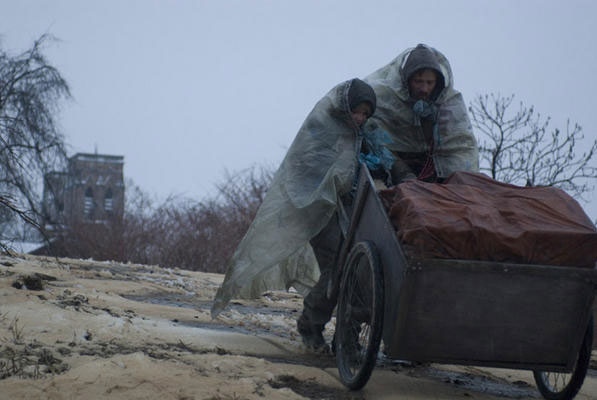
Advertising photo for The Book of Eli (2009). Courtesy of Alcon Entertainment.
Still from WALL-E (2008). Courtesy of Disney.
Still from The Vicar of Dibley television series. Courtesy of BBC One.
Advertising photo for Last of the Summer Wine television series. Courtesy of BBC One.
Former petrol station in Mountshannon, County Clare -- now a potter's shop.

Sunday, 9 May 2010

Footing turf

The Girl and I spent the morning in the boglands behind our property today -- we have gotten to know our neighbours, who have two girls her age, and they have become fast friends. The neighbours -- there are three houses, all in the same family -- own some bogland within walking distance of our home, and for fuel in the winter they dig their own turf.

Turf, as they call it here, is peat, smashed plants thousands of years old interrupted on their way to becoming coal. It's the main fuel here, and people used to dig rectangles of it out of the soggy ground with special shovels. I don't anticipate having to do this myself, but would like to know how, just in case.

Thus, our neighbours took me out this morning to foot turf. The peat is sopping wet, of course, when it is lifted out of the bog, which these days is done by hired machine. The machine leaves the peat in rows on the bog surface, and when it is partly dry it must be "footed" to dry further. My neighbour and I took the long rows of drying peat, broke them into bricks about half a metre across, and stacked them two bricks across and four bricks high, dry side down.

The Girl and her friends, for their part, made the bog their playground -- they turned over logs and played on stumps, and The Girl caught a frog.

Several things struck me about the bog. Most Irish do not appreciate what an amazing resource they have -- very few places on Earth have an abundance of fuel right below the soil. Even people who live next to a coal mine would have to travel many hundreds of metres into rock, braving poison gas and cave-ins, for a product -- coal -- that is smoky and acrid. Peat provides a slow-burning but intense flame like coal, rather than burning up quickly like wood -- but it provides an amazingly warm and cozy smell, something I wish I could take with me when I leave Ireland.

Another thing that struck me was to wonder how much was left of this resource. I have done some cursory searches, and I'm not sure if anyone knows for sure. The Irish have used peat more and more, even for generating electricity, and I'd be curious to plot its use on a Hubbert curve. Hopefully, I will be able to write more on this later.

In other news, our garden beds are doing well -- I filled another bed yesterday, so now we have three five-metre-long beds of seedlings -- peas, carrots, fennel, salad, leeks, kohlrabi and kale. To the side we have added smaller beds with loganberries, raspberries, redcurrants, blackcurrants, gooseberries and strawberries, and along the side of the property we have more trees and bushes to provide an edge to the herb garden. Later this year comes the greenhouse, chickens and more garden beds. Bees will probably have to wait until next year.

P.S. I'm still having trouble with the internet -- we don't have broadband where we are, and my wireless laptop won't always upload well, so I can't upload any photos from today. Sorry.

Tuesday, 27 April 2010

Future Movies I: The Road and 2012


Hollywood has an enormous power over the public’s perception of the world – Gandhi is one of my heroes, but when I picture him, I’m picturing Ben Kingsley. We, for our part, want the public to think about and prepare for a difficult future. So when Hollywood makes movies about what the future might be like, we should pay attention.

Unfortunately, though, Hollywood images of the future tend to be pretty grim: most video stores even have a single section now entitled “science fiction / horror,” since any future they show is likely to be horrifying. Just the last few years have given us The Book of Eli, The Road, 2012, I Am Legend, Children of Men, 28 Weeks Later, Resident Evil, Terminator films and series, and even WALL-E, the first post-apocalyptic children’s movie.

None of these films are a particularly realistic future either, but some of them are fine stories (WALL-E) and some are not (Resident Evil). Last winter, in The Road and 2012, we got one of each.

The Road manages to be both a good film and a respectful adaptation of an almost un-filmable book. Unfortunately, more people likely saw the advertisements than the actual movie, and may have gone in with the wrong expectations.

The trailer begins with a grainy montage of stock disaster footage – lightning, hurricanes, tornado, volcano, forest fire, rows of police running towards an accident. Like many trailers these days, it simply makes up random stuff and claims it’s in the movie; none of the Extreme Nature scenes appear in the film, but were apparently intended to help this film piggyback the blockbuster opening of 2012.

Worse still, in one of those jarring trailer flashes to white-on-black titles and surround-sound thud, the trailer states, “10 YEARS FROM NOW.” The events in the book and film do take place several years after The End of the World, but it’s an abstract setting rather than a Nostradamus-style prediction. It’s likely the fault of the studio and not the filmmakers, but it cheapens the film’s impact and comes at a time when our culture does not need even darker fantasies.

You see, The Road is as dire a future as we can imagine without going into supernatural territory. Everything but humans have died – nuclear winter is implied but never named – and there are no plants, no animals, no life. The sky is cloudy, “like some cold glaucoma dimming away the world,” the land is covered by a thick layer of ash, and the forests are stands of blackened shafts that crack and fall one by one.

The remaining humans turned to cannibalism, of course, and the few left tend to be the ones who won the struggles. What distinguishes the main characters -- called only The Man and The Boy – is that they will not resort to this even when it means their lives. It’s the one moral line they can still refuse to cross as they trudge across a Pinteresque landscape of nameless wanderers and spare dialogue.

That doesn’t sound like an appealing story, but millions have found the Pulitzer-Prize-winning novel worthwhile – author Cormac McCarthy’s spare prose is so well-crafted as to feel weightless, and pulls the reader swiftly along a difficult path.

The filmmakers did well at translating this world for the screen: familiar faces like Viggo Mortenson, Robert Duvall and Guy Pearce are almost unrecognizable under the caked grime, and the soundtrack is appropriately spare. They adhered reverently to the book’s thin and episodic plot, refraining from any of the usual Hollywood moralizing, crowd-pleasing action or neat resolutions. If anything, they went the opposite direction and omitted the book’s most shocking scene, perhaps careful to stay away from the lurid territory of slasher flicks.

The world of The Road, however, is probably impossible: No one has ever experienced a real nuclear winter, but even a constantly overcast sky should allow for plants – greenery exists in the near-darkness of the jungle floor, and on the shadowy edges of caves. The cold should also not preclude plants: grass and willow trees survive in polar lands where it is far below freezing almost every day of the year and dark for six months, so the above-freezing rain described in the book should not kill off the world’s life. Nor would radiation: as Alan Weisman pointed out in his book The World Without Us, the radioactive area around Chernobyl has become a lush wildlife sanctuary. If anything, our sudden absence would produce a profusion of life that we currently kill off.

Even if all the green plants in the world died, however, there should still be mushrooms and insects, as writer Ran Prieur pointed out -- mushrooms are mentioned once in the book, insects not at all.

I nitpick these details to emphasize that this world is just Cormac McCarthy’s thought experiment, the logical extreme of his usual desperate men scrabbling across stark landscapes. Science fiction once teemed with such creative-writing hypotheticals: What if everyone lost their memory? What if a generation were born blind and deaf? What if all the plants vanished?

If The Road tries to be a personal story in a purely imaginary setting, however, 2012 is its opposite: a $200 million steaming pile of distilled absurdity with pretensions of prophecy, backed with enough budget to feed five Chicagos’ worth of starving Third-World children. The resulting slick package invites you to thrill as the romantic leads outrun a fireball, cheer as the puppy is rescued at the last minute, and sigh in relief as all rude and ugly characters die discreetly off-screen.

The story begins with scientists huskily explaining that “Neutrinos have mutated into some other particle!" What that could possibly mean is anyone's guess, but apparently "it’s affecting the Earth’s core like a microwave!” A later video exposition claims that some vaguely-defined thing causes Earth’s crust to shift every 640,000 years -- we see a cartoon Tyrannosaurus Rex saying, “Not again!” The narration then claims that geologist Charles Hapgood believed this idea, that Einstein endorsed it, that the Mayans were the first to discover it, and that Christians called it the Rapture.

You can write a book with everything wrong with those few lines, but just to take a few examples:

• If life on Earth is wiped out every 640,000 years, are they saying life re-evolves from scratch every cycle? With hominids evolving back too? Are they saying one of these wiped out the dinosaurs 65 million years ago but never before, or that they died out 640,000 years ago, or what?

• There really was a Charles Hapgood whose book was endorsed by Einstein – presumably mentioned because Einstein is one of the few scientists people know. As far as I know, though, Hapgood said nothing about 2012 or the Rapture – his upheaval theory tried to explain why the continents seem to have looked different in the past, before scientists proved that they move slowly. Einstein, for his part, was a physicist, not a mystical prophet.

• According to any Mayan archaeologist I have read, the Mayans never prophesized that the world would end in 2012 – according to some, in fact, they didn’t have a concept of the End of the World as we do. Even if they had, however, why should be believe something because they did? Should we also begin sacrificing human slaves to angry gods?

• The movie drops the Rapture name for extra points among the megachurch crowd, both in the script and in the callous poster tag “Will You Be Left Behind?” But the Rapture, contrary to popular belief, is not the traditional Christian idea of the End of the World; it is specific eschatology invented in the 19th century by a British sect leader named John Darby, popularized among hippies by Hal Lindsey’s 1970 book The Late Great Planet Earth and later taken mainstream by the Left Behind series in the 1990s. It is not even remotely what most Christian churches believe or have ever believed, and is just as New Age-y as the 2012 idea itself.

I could mention all the other bits of 2012’s disaster kitchen sink – solar flares, bubbling wells, volcanoes, tidal waves over the Himalayas (!), and large sections of Nevada dropping through the ground into … um … that giant void that’s apparently inside the Earth. But you get the idea – in the paragraphs above I just gave more thought to the premise than the filmmakers did or than millions in the audience are supposed to.

If this story were obvious fiction, none of this would matter – people are allowed to like escapist candy, and filmmakers are in business. But like the Left Behind series, the 2012 fantasy predicts something terrible happening to this, real world, soon. The only difference is that the Left Behind authors seem to truly believe something ridiculous, whereas the filmmakers seem to be transparently capitalizing on people’s fears to make money. They can claim the movie is mere entertainment, but they didn’t make up an original ridiculous movie like The Core or Volcano: they are exploiting an existing wave of paranoia in a troubled people.

I devote space to this because, as I mentioned at the top, Hollywood influences how we see the world, whether we like it or not. We deserve stories that deal realistically with what families might face in the years ahead, and that present a hopeful picture of what life might be like. If you think this can’t be done, that might be Hollywood talking.

So what kind of futuristic stories would I propose? More on that next week.

Friday, 16 April 2010

London trip

I will be in London on business for my day job next week -- that is, if the volcanic ash from Iceland lets up by then.

If I go, there will be no blogging next week. I will be free the night of Wednesday, April 21st and the morning and afternoon of Thursday the 22nd. If you happen to be in London and want to meet for coffee, feel free to contact me.

Tuesday, 30 March 2010

More white stuff


It's snowing again. If you are living in Minnesota, as I once did, this will not be astonishing, but we are in Ireland, where it hardly ever snows -- maybe a light dusting once or twice a January, but no more. But this year we have seen some of the strangest six months this island has ever seen -- record floods in late autumn, the first White Christmas and New Year's in most people's memory, and several more heavy snows through the winter.

And it's almost April. Lord knows when we'll get that garden started.

Monday, 29 March 2010

Growing your own mushrooms

We tend to think of the natural world as consisting of plants and animals, part of a life cycle dimly remembered from old textbooks: one inhaling oxygen and the other exhaling it, one creating food and the other eating it. But there is a third partner at least as vital, without which the other two could hardly survive, repairing the world quietly from under our feet.

The ground you walk on is actually woven like a mattress, infused with millions of tiny threads of fungi -- eating wood, dead matter and even rock and turning it back into plant food again. We only notice them when it comes time for them to reproduce, and their “fruit,” sticking out of the ground, are mushrooms.

Some fungi forge an alliance with the aboveground trees, living on their roots and absorbing the nutrients they need. Others prey on tiny animals, luring them into traps and consuming them. In humid areas they form nets like spider webs, catching leaves before they hit the ground. They include the largest and oldest organisms on earth – one in Oregon covers 2,200 acres of land and is thousands of years old, but you can walk around on it and see nothing.

According to mycologist – mushroom scientist – Paul Stamets, mushrooms were the first living things on land, breaking down rocks like lichens do today and making way for plants – and after extinctions like the meteor that killed off the dinosaurs, “mushrooms inherited the Earth.” In his astonishing TED talk, “Six Ways Mushrooms Can Save the World,” Stamets also describes how mushrooms can be used to fight invasive insects, create cures for various diseases, create ethanol for fuel, clean up toxic waste sites and rebuild sterile land.

Mushrooms grow in most parts of the world, so people everywhere have harvested them for food, with knowledge passed through the generations: which ones are poisonous, where they can be found and in what seasons.

Our ancestors probably ate mushrooms extensively, and may have had far more of them. Most of the forests we see today are second- or third-generation after being clear-cut, and many of the “old-growth” forests are managed, their dead wood cleared from the forest floor. In the time of early humans, of course, old-growth forests stretched from Ireland to Japan and across the Americas, their trees sustaining many generations of fungi even before they fell.

Mushrooms add minerals to the diet and flavour to meals, and can be roasted, boiled in soups, sautéed, pickled or dried. We are not experienced in harvesting wild mushrooms and will not do so without being certain of their safety, but there are many other ways to gather them without buying the individual plastic packages at the supermarket.

Our family bought a giant box of mushrooms at a reduced price the last couple of autumns, when mushrooms are most common. Then we dried them and saved them through the year, using them again and again in soups and stews.

If you have a mushroom farm nearby, you can ask for some of the spent soil for your garden –it is often not completely spent, and yields some mushrooms along with your garden plants. Even if it does not, it is extremely fertile.

You can also order packets of mycelium – the fungi that yields mushrooms –to grow your own mushroom logs. We had oaken logs from a tree we had to cut down, and ordered three varieties – shiitake, oyster and lion’s mane – to implant in them.
The mycelium came to us through the post, three packets with several bullets of fungi in each. The first step for us was drilling holes in each log, a few inches apart. Then we had to hammer the mycelium bullets into the holes – hard enough to get them firmly inside the wood without smashing them.

Finally, the packets came with a block of wax and a wire daub – a short stick with a cotton ball at the end, like a Q-tip – to seal the mycelium in the holes. We had to melt the wax in a pot and carry it outside to the logs, and rush to dab the wax on the mycelium before it hardens. Fungi need the wood to be somewhat wet to grow, but if the mycelium is bathed in water too quickly, the spores may wash away before they can take hold.

Finally, the logs must be soaked in water for a few weeks so the fungi can more easily munch on them. I dug a trench behind the shed, about two metres across and 50 centimetres deep. I lined the trench with plastic, dragged the oak logs across the property to the trench, dropped the logs in the trench and filled it with water. Once the logs have soaked for a month or so we can lay them to one side and come back later.

It will take anything from six to eighteen months for us to get mushrooms out of this, and of course there is a chance they may never come at all – it is an experiment that demands some patience. On the other hand, it required only an afternoon of work, and if successful will yield home-grown mushrooms for years to come.

Photos: Won't upload for some reason. See them at Energy Bulletin.

Sunday, 28 March 2010

Spring


Last week was the first day of spring equinox, but the season itself comes when it wants to, and this year it’s coming late to Ireland. We have had six months of strange weather – unprecedented flooding last fall followed by an unusually cold and snowy winter, and the spring is up to four weeks late.

That’s just as well for us – we must rebuild our garden from scratch this year; we scrounged old scaffolding for the bed walls and yesterday got a tonne or two of old horse manure from a farmer friend, but before we put the beds together we must heft a lot of stones out of the ground. Irish soil is filled with glacial till anyway – people here joke that rocks are their main crop – and after the house construction our soil is also filled with builders’ rubble. Right now we have carted off about twelve wheelbarrows of rocks just from our front field, and we have the beginnings of a stone wall lining our driveway.

The good news is that Ireland has such mild winters – the last one notwithstanding – that some things grow here year-round. Salads and legumes are summer crops, but many root vegetables can simply be left in the earth here and picked whenever needed, and cruciferous vegetables like kale can be picked through the winter.

If your part of the world is still coming out of a harsh winter, you can still start your plants as seedlings, either inside, in a greenhouse or polytunnel or in cold-frames. Coldframes are simply boxes with clear plastic on top – often with one side higher than the other, so the top can slant towards the sun.

If you haven’t ordered seeds yet, get some heirloom varieties adapted for your climate – here in Ireland, we have Seed Savers in County Clare, and there are similar organisations in America and around the world. Buy seeds for more than one year to be on the safe side.

Look around for larger areas to garden beyond your own property. In all seasons, you can look for a legal community garden and jump through the appropriate hoops – advertising, door-knocking, meetings with local officials – but keep in mind places that can be used in case things go south quickly. Fields, backyards, vacant lots -- even parking lots could be filled with raised beds, as my group, FADA, did with our garden behind the Newbridge Town Hall. If you have an elderly neighbour, ask if you can garden their yard, and in exchange they don’t have to mow a lawn anymore and get a cut of the crop.

If you create raised garden beds, you can fill the bottom half with sticks to save on topsoil. If you or your neighbours get a newspaper, remember to recycle it or compost it into the earth – you can lay it over soil like mulch, with holes to let seedlings poke through. Ask your neighbours if they’d like to donate their lawn clippings for your compost – if it’s from their back garden, and not the roadside -- or check into last years’ hay. Offer to mow their lawn in exchange for the clippings.

This is the perfect time of year to pick bags of nettles, dandelion shoots, cowslip and scallions. We have bottles of cowslip wine, and I make nettle soup and freeze some for later in the year.

Everyone is spring cleaning and throwing things out --- in the UK and Ireland, check charity shops, boot sales and the Buy and Sell. In America, the Salvation Army, thrift stores, pawnshops, garage sales, Craigslist and Freecycle. I used to live in a college town, and every May 15 and August 15 was Free Stuff Day. Dumpster dive near college fraternities for the best material.

Finally, if your weather is getting nicer, get some exercise: Take a walk, bicycle or bring kids to the playground. As soon as I get these rocks out, I look forward to doing more of that myself.

Photo: The five-year-old, walking across wooden paths over the Wicklow Mountains.

Friday, 19 March 2010

Garden beds


We used to have garden beds here, but local ordinance said we had to build the house where the gardens were. So the beds came down, the house went up, and now the old boards are rotten.

Thankfully, we worked out a deal with someone for their old scaffolding, and tomorrow we start building the new beds.

And shoveling horse manure into them.

Wednesday, 10 March 2010

Update

My group, FADA, is still going well, although we’ve slowed down during this busy time of year.

We have begun hosting meetings of local families who are interested in growing their own, from town-dwellers with a small garden to professional pig and chicken farmers. The group is called GIY (for Grow It Yourself) Newbridge, part of a network of GIY clubs begun by former journalist Michael Kelly. GIY patrons include an array of Irish chefs, gardeners and media personalities -- Diarmuid Gavin and author/chefs Darina Allen, Clodagh McKenna and Joy Larkcom.

We drew about 30 people at the first meeting and about 30 at the second one – including new people, which is a good sign.

Also, some FADA members have also become Transition Town Newbridge, after the town in County Kildare where we meet.

For those who don’t know, the Transition Towns is a global movement that began in Kinsale, Ireland a few years ago. Geologist Colin Campbell, godfather of the peak oil movement and local resident, spoke in 2005 to a group of Kinsale students, and the class resolved to transition their region away from fossil fuels. The name and idea has spread rapidly -- there are now 274 Transition Towns across the world, in countries like Japan, the USA, Chile, Germany, the UK, Australia, New Zealand, Canada and Finland.

For many people, forming a Transition Town might be a bold first step, often taken by people who have recently heard about issues like peak oil and then found each other. In our case, it is a bit of an anticlimax -- FADA started here in County Kildare around the same time that the first Transition Town, with a similar idea and approach, was forming to the south of us in Kinsale, County Cork. They and we weren’t aware of each other when we started, but we soon learned of them, and our members and Transition Town activists have met and worked together ever since, as the Transition Town name spread rapidly.

In other words, we’ve always been a sort of unofficial Transition Town, and we’ve already spun off into two Transition Towns. Now we’re making it official and joining the global network.