This year
Catholics enter the most important week of their religious calendar with a new
pope, and if you’re like many of my colleagues, this doesn’t mean much to you.
I don’t see much writing about religion among the ecologically-minded, perhaps
because many are not very religious themselves, or perhaps they are avoiding that
most delicate of subjects. I want to make a case, though, that you should care –
perhaps about the new pope, and definitely about religion in general – as you
make plans for the future.
As a bit of
background, you might have heard that the last pope took the unusual step of
resigning a few weeks ago; popes usually hold the office until they die, and
the last one to willingly step down was more than 700 years ago. The new pope,
Francis I, is all kinds of other firsts – the first from the Western Hemisphere,
the first from the Southern Hemisphere, the first from outside Europe in 1,300
years, the first from the church’s 500-year-old Jesuit order, and the first to
be visited on their inauguration by the head of the Eastern Orthodox Church for
almost a thousand years. Unlike some of his predecessors he has been deeply
critical of the global financial system that has left so many Third-World
countries poor and indebted, and he has impressed observers with many small
gestures toward simplicity.
He now heads a
church devastated by massive sexual abuse scandals in several countries, and
will have little credibility unless he starts sacking people left and right for
covering up those horrific crimes. They were just the most recent blows,
however, to an already weakened religious empire.
Most people know something
about our clergy and rituals from mass media, for when Central Casting needs
someone to be demonically possessed or Whoopi Goldberg to wear a disguise, the
Hawaiian shirts of feel-good mega-church pastors just don’t cut it. We
represent all things arcane and traditional in Hollywood pop culture, yet that
same culture has made those traditions difficult to maintain. Our deliberately
paced rituals were not made for a world of ubiquitous iDistractions, or our
austere teachings for a world with the comforts and sexual freedom of Egyptian
pharaohs.
Recent popes made
some small concessions to a rapidly changing world – allowing the Mass to be
said in local languages rather than in Latin, for example – but they often just
alienated traditionalists, while not making the meaty concessions that many
modern Catholics want. If anything the Church has responded to the modern world
by forbidding more and more of it; formally opposing abortion in 1869, and
contraception from 1930. Pulled and pushed from many directions, a growing
number of the world’s billion-or-so Catholics silently question how many catechism
points they can disagree with before they need to start calling themselves
something else.
Today the world’s
largest denomination of the world’s largest religion is undergoing its own kind
of slow collapse – not vanishing, but shrinking rapidly in the First World. To
use one small but typical statistic, the seminary (school for future priests)
near where we live in Ireland ordained 558 priests in 1963 -- a mere 12 entered
last year. Catholics in the USA are melting away from the Church en masse,
their numbers only partly obscured by a flood of Hispanic immigrants. When I
returned to my hometown last year, where I attended junior seminary myself
once, I discovered almost all the Catholic schools had closed, and my old
church had taken out its cry room for mothers with babies – there hadn’t been
any in a long time.
Some former
Catholics I know have become militant atheists of the new breed, who embrace
nihilism not with mourning, as Nietzsche or Camus did, but with glee. Others
have been caught in the gravitational pull of the USA’s fundamentalist
movement, which has spent the last few decades building an extraordinary media
empire and absorbing more and more American Christians into its cultural
bubble.
Perhaps the
oldest surviving organisation on the planet, one that survived the rise and
fall of several empires and centuries of hardship, is failing in an age of overabundance,
most in the most abundant parts of the world. It needs to decide what kind of
church it wants to be as we pass into the next and particularly difficult era
ahead. So for Catholics, this is kind of a big deal.
I know, the
Church has a lot of shameful history – so does my native USA, or Britain, or
France, any other country or organization with a bit of history behind it.
Point to the Inquisition and I’ll point to one of your group’s original sins,
because there will be some. In each case, though, the past doesn’t necessarily
represent the present, nor do the shameful parts negate the brilliant parts,
nor do some decisions by a government represent all actions of a people. I’m embarrassed by some of my countrymen but
not ashamed of my country; it’s home to me, and I’m proud of its better angels.
Perhaps you have your own example.
To extend the
metaphor, Francis is being greeted by Catholics as Obama was in the USA. He’s a
demographic first that seems to reconcile a painful history, made in a time of
crisis and potential. As with Obama, however, people are projecting all kinds
of hopes and fantasies upon him, and some will inevitably be disappointed when
he does not walk on water.
 As I said, if you’re
not religious, none of this seems very important compared to the years of
global crisis we anticipate. We all know that our species is burning away the world’s
supply of fossil fuels upon which our economy depends, and disrupting the
weather in the process. We know that the living systems that keep the Earth
running are seeing one of their periodic mass extinctions – not an asteroid or
super-volcano this time, but a single ape species – and we know that past
crises didn’t heal on a human timescale. I’m right there with you.
Think about this,
though: What if you are trying to work against these trends, and rally others
to your cause? What if you are trying to build communities, or change the way
people vote, or organise protests? What if you want to assemble communities in
the country to become self-sufficient? And what if, hypothetically, your allies
hail disproportionately from specific subcultures – tech-savvy,
upper-class,
coastal, countercultural, socially libertine and irreligious?
We tend to live
in bubbles of people like us, and while social media has made it easy for
people to have geographically disparate “communities,” I find that most people
still communicate mainly with others of the same generation, education,
religious and political attitudes. If no one you know goes to church, for
example, you might forget that 40 per cent of Americans do, and forget to
factor that into your community-building.
Not all people
who don’t talk about their faith are nihilists, of course – some just walk
rather than talk, and I wish more people did. I’m not a fan of the current
fashion in the USA, where oversharing about faith became popular around the
same time as oversharing about sex and other private matters. If you want to
deal with others in creating a future, however, you must be prepared to deal
with the fact that most people believe in something, and that it will not and
should not remain tucked away under a basket.
For one thing,
religion often deals with the most basic assumptions of one’s life -- the visceral
and magical attitudes that underlie our political and religious affiliations.
Since we so often refuse to even examine, much less talk about, such attitudes,
we often engage in culture wars without talking about the thing we’re really talking
about. When an acquaintance of mine said he disagreed with evolution, for
example, I politely asked probing questions, and with each answer I was more
confused than before. He was intelligent and well-educated, and each sentence
was cogent and eloquent – but I didn’t see their relationship to the subject or
each other.
The problem was
that he began from the assumption that evolution was what some atheists think
it is, an anti-religion religion that evangelises a meaningless existence. I,
however, was referring to the evolution that scientists study -- the way that
living things change over time. (I know Richard Dawkins falls into both camps,
but most scientists I know don’t.) You could replace the word “evolution” with
“existentialism” and his answers would be much the same: Evolution can’t
explain everything. Evolution doesn’t comfort you in grief. Evolution won’t
save you when you die.
You could replace
“evolution” with “digestion” or “precipitation,” however, and they would have
made about as much sense to me. Does digestion explain everything? Does
precipitation comfort us in grief? Or, if we’re talking more about the history
than the process, replace the word with any historical event: does the Moon
landing address the problem of evil? Can the Civil War explain everything?
Religious beliefs
include, or are influenced by, such baseline assumptions, and much of their
jargon exists to separate people inside the group from outside. When someone
asks me if I’ve accepted Jesus as my “personal saviour,” or insists they are
“just Christian” of no particular type, it gives me a clear idea what type of
Christian they are.
Neglecting such a
powerful force in our lives, or its absence, prevents us from seeing their
effect on the political and social landscape – and how they are affected by it.
Take, as an example, the early 20th-century debate between
pre-millennials and post-millennials – which has nothing to do with people born
around the year 2000, and everything to do with how we think of the future. To
oversimplify, post-millennials believe humans could and should make the world
suitable for Christ before he returns, whether it be the Puritans’ idea of
suitable or Martin Luther King’s. Either way they tend to be optimistic and
ambitious in creating social change – in King’s words, “the arc of the universe
… bends toward justice.”
Pre-millennials,
on the other hand, believe that the world will get worse and worse before the
Second Coming, and their visions lean toward fatalistic, Zombie Apocalypse
territory – when you hear about “The Tribulation” and “The Rapture,” it’s
probably from a pre-millennial.
It might not be a
coincidence that the two seem to rise and fall with the fortunes of a country.
In the early 19th century, as the USA headed closer to civil war,
pre-millennial movements like the Millerites spread across the then-frontier,
hailing the end of the world until the “Great Disappointment” of 1844. As the
Millerites fragmented into many other groups – that’s where Seventh-Day
Adventists and Jehovah’s Witnesses come from – post-millennialism seemed to
gain steam, and their idealistic movements helped abolish slavery, invent
labour rights and give women the vote.
 As the USA became
the dominant global power, post-millennial churches remained powerful through
the civil rights movement. Then, as the country passed its domestic oil peak
and the public grew aware of ecological dangers ahead, an ecological-sounding
book called The Late Great Planet Earth
became a runaway hit – it’s often claimed to be the best-selling book of the
decade. That book inspired a growing pre-millennial movement among the young
and countercultural, which evolved into the nationalistic and somewhat paranoid
fundamentalism so influential in the USA now.
You’ll notice,
though, that both of these strains of Christianity pretty well parallel the two
visions of the future popular in the fossil-fuel era. In the mid-20th
century, when Westerners saw rapid technological and social progress, the
gospel of progress affected not just religion, but politics and science.
Evolution was reframed as the ascent of Man, my country’s expansion reframed as
Manifest Destiny, history as the March of Progress. When my country’s tables
turned in the 1970s, not only did the religion get apocalyptic, but politics
and popular culture did too.
Whether the
religion led or followed the other trends is difficult to say, and of course
not everything falls into these neat categories – apocalyptic thinking was
around long before the first oil well – but their popularity does seem to rise
and fall with energy inputs. If this pattern holds, we might expect to see
pre-millennialism – what I’m calling “fundamentalism” - continue to be one of
the few things that boom as fossil fuels decline.
That could be
very bad news for the rest of us if they persist in attacking basic science
education in my own country, because of their aforementioned ideas about
evolution. People can have their own opinions about gay marriage or abortion –
there are good people on all sides of these issues, and we can sort out our
differences democratically. We can also have respectful differences about our
faith in the unproven. We do not, however, have to respect someone’s faith in
the disproven, and a generation without science education is the last thing we
need as we enter an ecological crisis.
On the other
hand, I’m throwing around terms like fundamentalist, evangelical and
mega-church as though they were interchangeable, and of course there are many
divisions and nuances. I know many fundamentalists who would make bitter
flame-war enemies online but great neighbours in a real-world crisis. I also
know others whose faith has inspired them to adopt a more traditional way of
life – and in doing so pave the way for the rest of us. Also, many groups settle
down over time, or we soften toward them; we don’t think of the “Salvation
Army” as being a genuine army, say, getting into shooting wars with gangs, but
once they were and did.
None of those
religious groups, though, completely abandoned their belief in progress, and
these days most people across the political and religious map tend to celebrate
progress in some area – whether it be newly broken cultural taboos or newly
vaulted Dow numbers. Most people I know, of any political or religious group,
feel perfectly comfortable questioning their opponents’ version of progress,
but respond indignantly to any questioning of their own version.
Of course we have
progressed -- few humans have experienced our level of comfort and freedom, our
health or literacy. We live in an age when humans live eight decades, and with
a few touches of a finger can connect to the wisdom of the world. Yet most of
those changes exist because of fossil fuels and the technology they allow; that
cheap-energy window appears like a needle along the timeline of humanity, and
as we pass over one peak after another we need to think about what parts of
progress are objectively right and necessary for our descendants. Nor has the
freedom to choose every aspect of our lives necessarily made us happier, as far
as such things can be measured, than people who did not have such choices.
The myth of
progress also doesn’t allow us to say no. It assumes that if a little of
something was a relief to oppressed or impoverished ancestors -- wealth,
choices, entertainment, anything – that we have to keep following that trend
forever. It doesn’t allow us to stand astride history yelling “Stop!” It
doesn’t let us say when we’ve had enough, even when the enough we have is
temporary. That’s what
religions are supposed to do.
 Religions done
rightly – which usually means traditions that pre-date the cheap energy window
–go against today’s left and right alike, and violate every value we learned
from generations of stump speeches, motivational seminars and Disney movies. They
don’t tell you that you should always follow your heart, or that you are
destined for greatness, or have a right to choose whatever path you
want, or
that everything will work out all right in the end.
It tells you that
you are frail and flawed, here only briefly, that your problems are not very
different than everyone else’s, and that we are all in this together. They give
our mayfly lives an umbilical cord to eternity – and even if you don’t believe
that happens on a spiritual level, the tradition does in this world. There
aren’t many institutions that allow us to cite the centuries of the second
paragraph, or whose still-standing monasteries kept learning alive through the
end of the Roman Empire.
Now another
empire is declining – the USA specifically, and the globalised consumer culture
in general. In Walter Miller’s novel A
Canticle for Liebowitz, a group of Catholic monks preserve the bits of
Western Civilisation after a nuclear war, sometimes without understanding it,
until the world is ready for it again. The real collapse will probably not be
as dramatic as a thermonuclear exchange that seemed so imminent when it was
written five decades ago, of course. It will likely be more of the small
crashes and crises we have seen in the last decade, giving us a bit of space to
do something like the monks of the novel – or the real ones fifteen centuries
ago, whose ruins dot the fields around us.
So let’s say you
want to help your descendants transition into as humane and civilised an
existence as possible, even though you won’t be around to see it. You want to
teach children to live a more sustainable life of less consumption and energy
use, even when a million distractions around them tell them to do otherwise. To
live out this vow of poverty you might need to encourage them to withdraw from
the world, as St. Benedict did long ago, and build a community of people who
believe the same. You will need to inculcate strict code of restraint in your
congregation, and teach a set of rituals that will help people succeed at this
new life.
There – you’ve just become religious. Whatever your opinions
about the supernatural, you have a set of traditions, rituals and values that
sustain you through hardship. There are many
traditions you can draw from, of course – I have mine.
Perhaps you have
your own example.
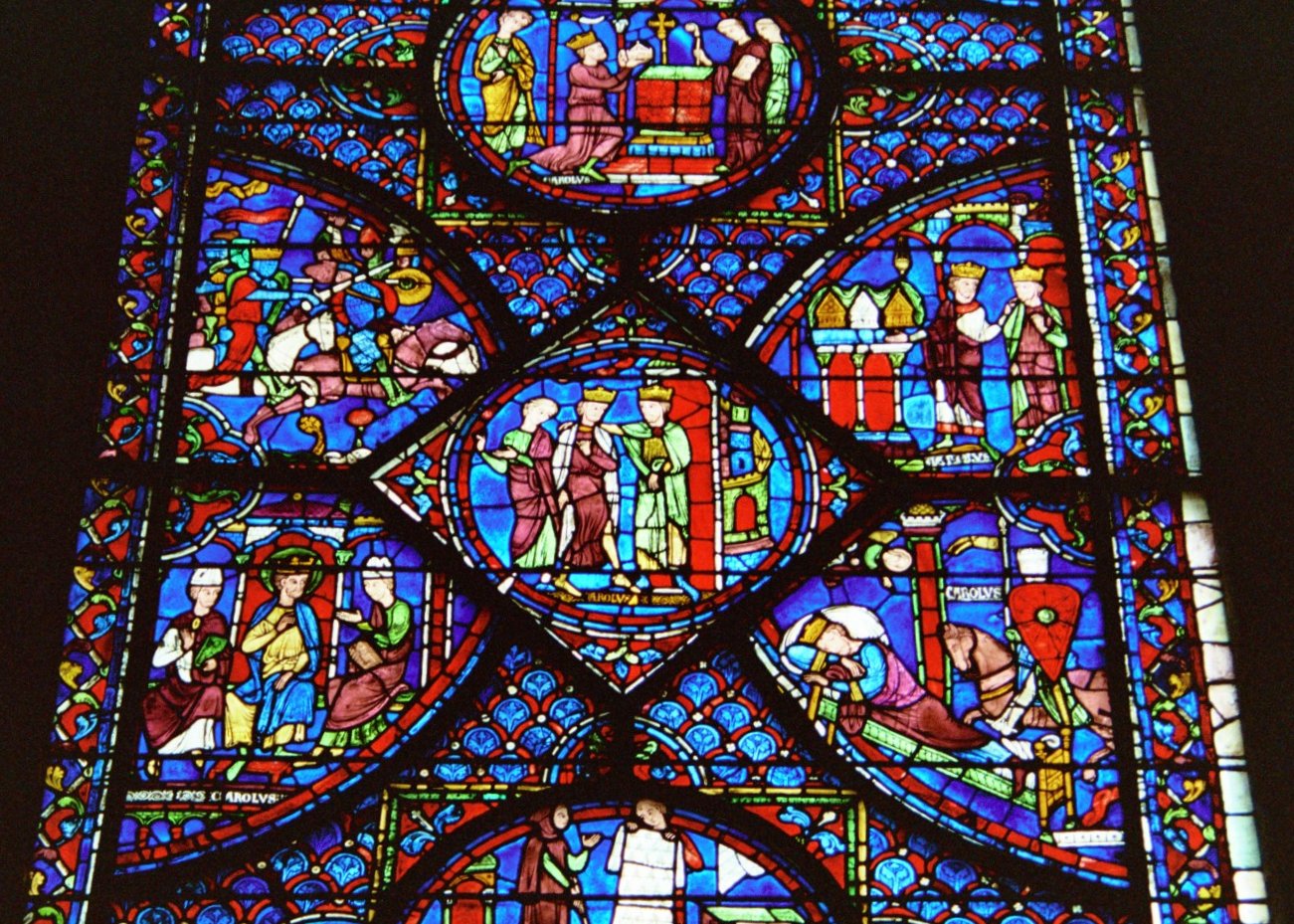
Top photo: Window of Chartres, courtesy of Wikicommons.
Second photo: Priests emerging from the seminary at Maynooth near our home.
Third photo: Priest blessing a gardai (policeman) in Ireland. Both these photos seem to be from around the 1930s and are used with permission from Irishhistorylinks.com.
Fourth photo: The graveyard at Glendalough, a monastery built in the 500s.
Final photo: The stream at Glendalough.