Wednesday, 13 October 2010

Riding the rails

My day job sent me to the Book Fair in Frankfurt, Germany last week, and amid the frantic schmoozing that such events require I was able to steal away for a bit and enjoy the city again. Frankfurt, my wife and mother-in-law’s hometown, remains a pleasure to visit, with museums, parks, great restaurants, shops and the kind of tree-lined neighbourhoods that movies use as shorthand for innocent beginnings and happy endings.

One reason it’s great to visit, though, was that you can actually get to the museums, shops and neighbourhoods quickly and easily, using buses, trams, trains, subways, and sub-subways that run under the first set of subways. Even a visitor with limited German and no car has the freedom to go almost anywhere they fancy; imagine, by contrast, speaking no English and trying to navigate Phoenix or Des Moines.

Of course wasn’t all museums and parks; certainly there were industrial and warehouse districts too, necessary but less of an attraction, and for all I know there may have been slums somewhere. In any area I visited, though, the streets were lovely, the traffic was light and the sidewalks thick with walkers, bicycles, cafĂ© tables and vendors. Most importantly, they felt like neighbourhoods threaded with capillary streets, rather than buildings built alongside highways. In short, Frankfurt looks like American cities used to.

It’s difficult to imagine many of the cities in my native Midwest –rivers and lakes of asphalt that fall out of sight only with the curvature of the Earth – as they were a lifetime ago. For more than a hundred years, from the 1830s to as late as the 1950s, most US cities were networked with a web of streetcars – first powered by horse teams, then electric cables – that acted as a circulatory system from one end of a city to the other, and across the generations.

Read accounts of day-to-day life in streetcar-era America – or just a city that still has them, in Europe or the Third World today -- and you see how subtly such transport changes the feel of cities. Homes in old neighbourhoods appear remarkably cosy and close together – not just slums, but upscale houses as well – because they didn’t need garages or an oil-soaked car park. People left their homes and entered the world, not their SUVs. Cities could be compact, keeping food production close to food consumption and limiting, for each resident, what would later be called an “ecological footprint.”

Streetcars seem slow to modern eyes only because we compare them to a car on the motorway; compare them to a car in the city and they may have been faster. One of the Dublin lines ran out to the suburb of Lucan a hundred years ago, and passed through town at 25 miles an hour -- a goodly speed in Lucan's daily traffic jams today.

Children could play in the street, for there were few cars. Streets in old photos appear clean and graffiti-free, not because people were necessarily more angelic in 1840 or 1940, but because thousands of people walked on them every day, so vandals had little privacy – and once graffiti was there, someone was more likely to clean it up or complain to city officials.

My grandparents met and fell in love while riding the St. Louis streetcar together, shortly before Judy Garland would sing a love song to that city’s public transportation system in the 1944 film Meet Me in St. Louis. At that point the system had been running for almost a century, and similar systems, according to Randal O’Toole of the Cato Institute, ran in every American city with more than 10,000 people. According to historian Bradford Snell, 90 percent of all trips in the 1920s were by rail; only 10 percent of Americans needed a car. It echoes what my grandmother used to say, that no one she knew needed to drive.

After World War II, however, my country’s cities were transformed; most of the streetcar lines were reduced, sold, cancelled and destroyed, many by a coalition of car, tire, oil and truck companies. Those companies -- Standard Oil, Phillips Petroleum, General Motors, Firestone Tire and Rubber, Federal Engineering Corp, Mack Manufacturing (of Mack Trucks) and the streetcar companies they bought up -- were found guilty of criminal conspiracy in 1951, and fined $5,000 each.

Snell believes the corporations were not just trying to monopolise streetcar lines – the actual charge – but consciously conspiring to transform America to a car-dependent society, and of course succeeded. Backing him up is Noam Chomsky, who accuses the corporations of committing “the largest social engineering experiment in human history.” On the other hand, writers like O’Toole maintain that rails were a “disaster,” and that market forces made them obsolete.

Certainly cars and highways were expanding during the cheap-oil window, and many rail systems were ripped up in Europe as well – Dublin used to have a network of streetcars as well that vanished around the same time. At the same time, it seems doubtful that oil, car and tire companies were buying up their competition in the hopes of expanding it. When they bought out the streetcars they didn’t just tighten belts – they destroyed the infrastructure, ripping the rails out of the streets and paving over their grooves, effectively salting the earth.

Today, unless you live in New York or some other pocket of public transport, getting around a US city presents a genuine challenge. Light rail is rare, and even bus lines can be limited, unreliable and expensive. Finding a job, getting clothes for an interview, getting to a temp assignment – all are extremely difficult without a car. Car payments, insurance and petrol can take up a sizable chunk of one’s paycheck, locking many people into an unending cycle.

Most older Americans I know used to walk everywhere, or at least to the bus or streetcar and back, getting exercise and meeting their neighbours. Today, Americans are infamous for their unwillingness to walk – I have talked to more than one European who said they tried to walk along an American street and drew rubberneckers, or were stopped by police.

Our cities are now built around the fact that there is about one car for every American. Half of all urban space exists for cars, the other half for people. Many newer suburbs don’t have sidewalks, since the expectation is that people will leave their homes mainly to get inside cars. Many new minivans have televisions, a feature that assumes children will spend a hefty chunk of their childhood in the back seat.

In my own country, a few cities have tried to restore pieces of the old transportation system, with light rail instead of streetcars – Minneapolis has the Hiawatha Line, St. Louis the MetroLink. But most of these are, or were until recently, single lines. They were a blessed relief for thousands who wanted to use them, but they ran from point A to point B without any other rail lines around. No one, when building the highway system, thought of building a highway that would run only from point A to point B without connecting to any other roads.

Even these lines only came about after decades of bickering in city councils and planning boards. Minneapolis’ Hiawatha line, for example, lingered for years in legal limbo, and while it has been wildly popular with most residents in its first six years of use, it retains the hatred of a few. Anti-rail activists paid for billboards across the city featuring the train line against a red star – perhaps implying that having freedom from traffic was like being in Soviet Russia – and even now the occasional candidate runs on a platform of ripping the rails out.

The few accidents – about one a year, when a driver foolishly tries to drive in front of an oncoming train -- have made screaming headlines and memorials from anti-rail groups, while the thousands of car-on-car accidents in the same city are not used as an argument against more roads.

Critics of such public transportation lines claim that the trains are mostly empty, a claim easily disproved by anyone who’s ever tried to squeeze onto one. Even if that were true, for example, no one ever points out that the cars on the highway are also mostly empty.

Another charge made against streetcars and light rail, and the usual excuse for the post-war destruction, is that they don’t make money. But how much money did the road in front of your house make last year? How much money does our asphalt make, or our electric wires, or our sewage pipes? The questions are ridiculous because these are not moneymaking enterprises; they are basic infrastructure, one of the legitimate reasons for paying taxes or having a government.

One problem is that recent light rail projects – again, take Minneapolis for example – committed to an ambitious plan involving house demolitions, rerouted streets, and earth berms and walls to protect nearby homeowners from having to see a colourful train go by or hear its electric hum. As impressive as the Hiawatha line is, other cash-strapped cities might look at that project’s $700-million bill and write off the idea of light rail altogether. But other cities don’t need to buy real estate and tear a path through neighbourhoods to build public rail. Your city, and every city, already has hundreds of light rail paths already cleared for rails, running like arteries to all the major population and business centres --- they’re called roads.

Take Dublin, whose Luas line runs right through the city’s crowded shopping district. Like Minneapolis or St. Louis, Dublin built back its rail system recently, a small but happy fraction of the network it once had. Here, though, officials here set rails right into the asphalt like streetcar rails, and the train runs down the city streets – which are also narrower than most American streets and turn tight corners.

Conservative activists Paul Weyrich and William S. Lind, in their 2002 paper Bring Back the Streetcars!, said looking at old photos of streetcar cities “is almost painful. It reminds us of a world we had, and have lost. But it does more than that. From the standpoint of public transportation, it points not only to the past, but also to a possible future.”

Almost two dozen US cities are considering streetcar systems, according to recent news reports, and such projects could be a godsend for restoring the urban communities, low carbon emissions and easy transportation that we used to have. They could pull together political groups that never imagined having common cause; urban activists who want to revive urban neighbourhoods, suburbanites hit by waves of recession and fuel prices, environmentalists who like the potential for zero emissions. To lobby city and county hall, however, these groups would have to accept a responsibility from which many Americans have fled; to work with people who believe different things than you do.

Unfortunately, streetcar or light rail projects grow more difficult each year; unless the world discovers a surprising new source of energy or a new bubble propels the US economy aloft again, cities are unlikely to build new subways or Els, and new ground-level transport will have to endure a volatile market, lack of funding and spotty delivery of supplies and replacement equipment.

Buses, of course, service every major city, and in abundance can fill the streetcar gap. Anyone who rode buses in a variety of cities, however, can tell you that many bus systems struggle as well. As mentioned, some bus lines habitually run late or not at all. They can be expensive for the financially-strapped people most likely to need them. In many places they carry a stigma of poverty. Many cities lack bus lanes to allow buses to bypass traffic, meaning that bus rides are no faster than driving one’s own car.

Of course, most US states will struggle even to maintain the existing bus or light rail lines, even as the need for them grows. Most state and local governments are desperately scrambling for new ways to cut corners – turning out streetlights at night, shortening the public school week, shutting down services. Cities across the Western world are shaving off their basic transportation services as well, and they will be the first to go in a crisis.

Which is a perfect reason for anyone reading this, whatever your party or position on the political map, to learn to be an activist. City and regional governments are often harried, unappreciated and malleable in a way that the federal government is not. This is an issue that anarchist Noam Chomsky and Moral Majority founder Paul Weyrich can both get behind, and so could Tea Parties, Green Parties and many other parties in your area. All of you deserve to have at least as much freedom and mobility as American city-dwellers enjoyed in pioneer days.

Otherwise, what little we have will disappear while we fight over other things, until the next economic dip or fuel crisis turns every neighbourhood into an island.
Next week: tips for keeping the public transportation system alive in a bankrupt city.

Resources:

Documents of court case UNITED STATES, v. NATIONAL CITY LINES, Inc., et al.
http://bulk.resource.org/courts.gov/c/F2/186/186.F2d.562.9943-9953.html

Bring Back the Streetcars! A Conservative Vision of Tomorrow’s Transportation, by Paul Weyrich and William Lind, 2002
http://www.apta.com/resources/reportsandpublications/Documents/weyrich4.pdf

“The StreetCar Conspiracy: How General Motors Deliberately Destroyed Public Transit,” by Bradford Snell, The New Electric Railway Journal, Autumn 1995.
http://www.lovearth.net/gmdeliberatelydestroyed.htm

O'Toole, Randal (2006). "A Desire Named Streetcar How Federal Subsidies Encourage Wasteful Local Transit Systems" (pdf). Cato Institute. (559): 1–16. http://www.cato.org/pubs/pas/pa559.pdf.

Span, Guy "Paving the Way for Buses-The Great GM Streetcar Conspiracy" Part 1 || Part 2, San Francisco Bay Crosssings.

“22 Cities that May Have New Streetcar Lines Within 2 Years,” Scientific American, 18 April 2010:
http://www.scientificamerican.com/article.cfm?id=22-cities-that-may-have-new-streetc-2010-04

Photos, top to bottom:
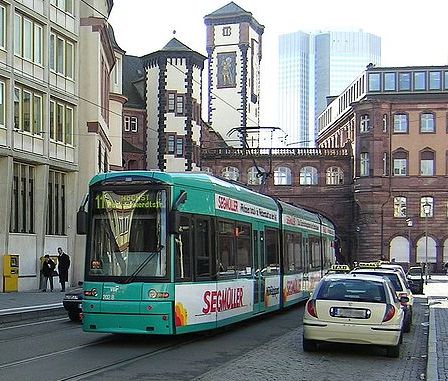
The Frankfurt S-Bahn. Photo courtesy of WikiCommons.
St. Louis circa 1925 - photo courtesy of skyscraperpage.com.
Map of the St. Louis streetcar system circa 1940 -- the distance from north to south is about 25 miles. Public Domain.
Map of the Dublin streetcar system, circa 1920 - map covers a similar area. Public Domain.
Los Angeles today. Photo courtesy of the U.S. Dept. of Commerce.
1950s streetcar in Howth, outside Dublin, in the 1950s. Public Domain.
The Hiawatha light rail in Minneapolis. Photo courtesy of WikiCommons.

Monday, 27 September 2010

Update


In lieu of more extensive blogging, here is an update of what we have been doing lately.

Pickling: radishes, cabbage, cucumbers, gherkins and onions.

Drying: Calendula flowers (poor man’s saffron), poppy heads, sage, bay, beans, peas and onions

Jamming: Strawberries

Syruping: Elderberries

Boxing: Chicory roots in crates of earth for winter salad

Sprouting: mung beans and clover seeds

Making: milk into yogurt, yogurt into cheese

Boozing: berries into liqueur, elderberries into wine.

Photo: Our neighbour driving his old car past our house.

Sunday, 12 September 2010

Alone


I don't often link to other people's blogs, but this blog by Bill Sepmeier does a good job of describing how difficult it is to be "off the grid" in any meaningful sense.

Because of my writing and the taglines often posted below it by the Daily, I am known locally for “living off the grid," Sepmeier writes.

It’s true, to a degree. Over the past several years I have built and installed enough renewable electric power systems at my home and office to provide all of the electricity I need to live and work as I do, where I do. There are many grids in modern life however, and living without them is not a simple matter, even if one’s personal lifestyle systems; one’s house, hearth and energy supply are sustainable and, compared to most, irrevocable.


As long as people have been dissatisfied with the direction of mainstream society, they have desired to be self-sufficiency, from the Irish monks at Skellig Michael or Glendalough, to the Shakers or New Harmony colonists in 19th-century USA. In recent years, it seems, the desire has increased, undoubtedly because people understand the mainstream society will not continue its exponential growth for much longer. And if we were used to the life of 19th-century settlers, we could do so easily: set us loose in a Wal-Mart of inexpensive tools and dry goods, give us a car for cheap and fast transportation, and we could make a homestead easily.

The problem for us, of course, is that adopting such a life would be hardship. It would be for me, too -- I want medicine when I am sick, daily showers, deodorant. Most people have little experience even cooking meals, much less planting seeds, growing vegetables or caring for animals. Most of us are spectacularly ill-equipped for a "self-sufficient" life -- it only arises as a goal in the minds of people who see it as an ideal in the misty distance, as children might think of being married.

Thankfully, we don’t need to. Little House on the Prairie images aside, most pioneers did not travel alone across the prairie – they moved in long wagon trains with the intention of forming communities when they settled. Irish monks, Shakers, Oenidans – none of them aspired to live and die alone, but with others who believed as they did. We, with our inexperience at traditional living, need such company far more than they did, and need self-sufficiency far less.

A friend of mine used to work with County Waterford farmer John Seymour, who ranks with Wendell Berry as an idol of Greens, back-to-the-land evangelicals, crunchy cons and others. Seymour wrote the book – many books – on self-sufficiency, and my friend was shocked to hear Seymour say that he had placed too much emphasis on that idea. What he should have emphasized more, he said, was mutual sufficiency. Most of us now already live lonely lives, and we aspire to make them lonelier, believing that such a life could ever be sufficient.

Photo: The girl at an altar in the ruined cathedral atop the Rock of Cashel.

Wednesday, 8 September 2010

The Cave


The Girl and I took a tour of Ailwee Cave, discovered by a farmer on the Burren and kept secret for decades. It formed from the torrent and disappearance of the meltwater from Ice Age glaciers, water that bore tunnels and cathedrals in the center of the mountain.

One section had a hollow in the floor, the sleeping spot for generations of bears, while another was a vertical striping of limestone, like a pipe organ.

This is a waterfall, several metres high, that pours through the cave.

Wednesday, 25 August 2010

The Journey West


Last weekend we went to the West of Ireland, where The Girl and I spent a full day driving through Conemara, the pastoral land to the north of Galway Bay. We meandered over the rugged countryside, stopping often to picnic, run around, take pictures, feed birds or climb hills.

We then went south through Galway to the stark and windswept moonscape of the Burren, where the one of Cromwell’s generals once complained there was not enough soil to bury a man there, enough water to drown him or enough rope to hang him. The advance and retreat of ice ages and the tapping of meltwater carved the limestone rock into ripples, eddies or strange marbled designs, or eaten vast caves through the bellies of the mountains.

At Ailwee we saw a bird show at the Raptor Center, which delighted The Girl. The organisation takes in birds that have been injured or captured in the underground animal market, breeds them and trains them to perform in the shows that fund the place.

A bit up the trail is the entrance to Ailwee Cave, which trails for kilometres under the rock – an Irish farmer discovered it in the 1940s and kept it secret for the next thirty years, finally selling it to people who made it a tourist attraction. The Girl found the cave itself a bit scary -- underground cliffs, dripping ceilings, claustrophobic walkways – and, for one moment when the lights went out, total blackness. She put on a brave face, but held me tightly, and I didn’t mind --- she won’t do that forever.

Near the caves we saw the Poulambrone Dolmen, one of the many stone tables built by Celts long ago, like a piece of Stonehenge. The Girl absorbed the stories I told her about the people long ago, but was more interested in playing hopscotch across the jigsaw patterns in the ground.

I wanted to see the Cliffs of Moher for the first time, but The Girl was tired and rain had begun, so we headed back. I visited the Cliffs of Moher ten years ago when I first came to Ireland, but never saw them – it was so foggy that I couldn’t see three metres in front of me, and I wasn’t walking too close to the Cliffs. The Irish have a different sense of public safety than most Americans – in front of a sheer drop of fatal height, I recall only a small sign saying, “Warning: Cliff is dangerous. Stay back.” No fence, no railing – not walking off the cliff is considered your responsibility. Giving the driving winds there, I wasn’t bringing The Girl too close either.

The next day we saw Ireland’s national Museum of Country Life, dedicated to preserving the images and crafts of the old ways of Irish life. It’s a fascinating place, and I recommend it to anyone passing through that area of Ireland, with one caveat: for a museum devoted to preserving the customs and crafts of country people here, perhaps they could have created a building that looks less like something by I.M. Pei.

One advantage to living in Ireland is that a more traditional way of life was preserved longer than in other places, simply because people couldn’t afford anything else, so museums like this have clothing, tools, shoes, chicken coops, ropes, fishing nets and dozens of other items made entirely by hand, but from only a few generations ago. The last people to live with almost no technology here when Jimmy Stewart was making movies, so places like this have recordings, interviews, and film footage. Such places become even more interesting if you, like us, believe that we need to keep such knowledge alive.

Thursday, 29 July 2010

New article

For those interested, my article on Ireland in the recession is now on Big Questions Online -- go check it out here.

Monday, 12 July 2010

Infrastructure


As I mentioned, when we finished our home and moved in last Christmas, the fields in front of our home were mud and builders’ rubble. Now we have four garden beds in, built only in the last eight weeks, we have planted a number of trees for fruit, nuts and firewood, but have not yet begun building our greenhouse and chicken run.

Having these things does not make a family completely self-sufficient, for there is no such thing, nor would it be desirable. We hope they might allow us to provide for themselves and their neighbours if the economy erodes further, or if petrol becomes more expensive, or if stores run out of goods, or if any one of a hundred crises come to pass at some point in the next few decades.

There are two problems about such projects: first, they cost money and/or time to build, which people are reluctant to give. This garden has taken us two months to build so far, working on weekends and after work, and has cost a few hundred euros. Wood for beds must be bought, beds must be assembled, trees must be bought and planted. Crops must be watered regularly and maintained, and perhaps for an hour or more a day.

The other is that very little of this will yield any goods anytime soon. A planted willow shoot might yield firewood-sized branches in a few years, and every year thereafter – but you still have to wait a few years, and then a few more to dry the wood. You can make kitchen waste into great topsoil, but it takes a year. You can plant asparagus, but it will take two years to come to crop.

This might be the biggest challenge we face as we prepare for the leaner years ahead: not knowledge or will, but infrastructure. The word is usually used to mean highway overpasses and broadband nodes, but beds, tools, sheds, firewood stoves, saplings, paths, coops, hutches, vines and ditches are infrastructure too, and they multiply ten or twenty times the amount of food you can get – but they take an initial outlay of time and effort. But this is the time to start building it, when many of us have money, cars, goods in nearby stores and a way to get them home.

So think of how you can get the most productivity out of every square centimetre of your property, or whatever property you can use. Think of what people might need during years of depression ahead, and start building it now.

Start now because most such tasks are difficult at first and get easier with repetition; our first garden bed took us a whole weekend to build slowly, while the fourth one took an hour. Start now because even the simplest of processes take time – you can start composting vegetable waste tomorrow, but it will be at least a year before you see it turn to earth.

Start now because many of us are unaccustomed to physical labour and must build our strength. Start now even if that garden bed stays empty for the first year, or even if you need practice with those tools, or even if the trees are still saplings. Start now because the more people are doing it, the more normal these actions will become. Start now because we have to take our opportunities when they come.

Tuesday, 25 May 2010

Garden beds


Gardening, always a popular hobby on these islands, has boomed in these touchy times: grow-your-own programmes seem to fill television schedules, and millions of people seem to be cleaning off the old tools in the shed and seeing what’s under their lawn. And good for them: if you have a big yard of deep soil, that’s what you should do with it.

Not everyone has such favourable conditions, however. Most people don’t live in the country, so maybe you live in a flat (apartment), maybe in a narrow row house, maybe you have only thin or contaminated soil, or only asphalt – ten percent of the arable land in the USA has now been paved over. If so, garden beds create an easy way to grow crops almost anywhere.

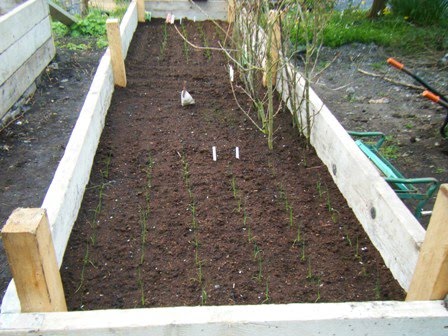
A garden bed can be as simple as a raised area in a boundary of sticks or stones, both for aesthetic reasons and to enclose the plants. We’ve built several of those in the last few weekends for our berries, herbs and salads, which don’t require deep soil. If you have asphalt or contaminated soil, or want to grow beets, however, you probably want something deeper, and that probably means either bricks with mortar or wood planks, stakes and screws. We made the latter -- metre-deep, five-metre (15 feet) long beds – over the last few weekends.

We have an acre or so of land but needed beds anyway – for reasons of geography we wanted to plant in the field in front of our new house, but that’s where my parents-in-law’s trailer used to sit, and the ground had compacted into concrete. Plan B: put the garden beds back.

We needed wood, and that’s expensive these days – to create six five-metre beds we needed 1,300 euros ($1,600) worth of wood – not even counting the stakes we needed to secure the corners, a few hundred euros more. Luckily, we found a home scaffolding business only a couple of miles away, and he had plenty of planks that no longer met safety requirements for third-floor construction but suited us just fine.

To build the beds themselves we laid scaffolding planks two long and three broad across three of the stakes -- one stake held each end, and one more held the middle. We screwed the planks into the stakes with three-inch screws, and that was one side of the garden bed. Three more planks across each end completed the bed, so heavy it took four people to lift into place. We dug the topsoil out of the space where the bed would go, placed the bed in the space, and measured every side and corner to make sure it was level – where one side was too low, we wedged rocks underneath.

The next step was to fill the bottom half of the beds, not with soil, but with sticks – in our case, sticks my father-in-law and pollarded a couple of years ago, before his passing. The sticks serve many purposes: they drain the soil in this wet climate, and allow root vegetables to grow deeply into the space below. They take up the depth into which few plants would reach, so we don’t waste manure filling the bottom half. They can help form a barrier against weeds, which will not grow vertically through wood or air pockets. Stones or gravel would also suffice.

We ran out of willows on the last bed, and used some from the cherry tree we chopped down – we eventually decided that tree rot would not affect cabbages. We also used a few from the lilandia that ring our property – but sparingly, as they are evergreens and we don’t want soil laced with turpentine. By the way, never fill your bed with live branches, especially willow -- my mother-in-law did this by mistake, and spent years clipping out shafts of willow tree that kept popping up between the carrots.

Speaking of manure, we were lucky here as well – a farmer friend of ours had some horse and cow manure, two years’ ripened so that it smelled and felt like soil rather than poo – and was willing to truck it in. For weeks we’ve been the proud owners of a two-metre-tall manure pile that we have to ease the car around to get out the driveway, and we’re happily reducing the pile more each weekend.

For former car parks (parking lots to Americans) you can do the same thing. Last year my group, FADA, was looking for a community garden, and we acquired the rights to use a former car park behind an old church. There too we built beds a metre high – wheelchair height – and have used them for classes in everything from seed saving to food preservation.

All this work and expense might seem intimidating – we could have used these hundreds of euros and weeks of work to just buy the vegetables in the first place. But that misses the fact that garden beds will last up to 20 years – my mother-in-law’s lasted 15 and were going strong when they were torn down – so this is constructing not just for ourselves, but for generations ahead.

As crowded as most cities and suburbs are, most of their space lies unused, and while Victory Gardens could spread across the backyards, beds could fill many lots, corners and crannies. They could fill the driveways of many suburban homes, where people don’t have a car or can park on the street. Small ones could be placed on rooftops or balconies if the structure can hold them – perhaps nourishing raspberries and other climbing plants that could creep down the side of the building, yielding food and reducing glare.

They could cover the parking lots of stores that have shut down, even as the glass storefronts are turned to greenhouse space. They could be set along playgrounds and schoolyards, providing entertainment for children and free snacks. They could be wedged onto roadsides and street medians – not growing food in that case, but plants that can suck up car fumes and make the surrounding air cleaner, as plane trees did the London smog.

Look around. What space – vertical, horizontal, roof, cellar, sewer, anything -- isn’t being used for growing food, or firewood, or raising animals, or keeping people warm or cool? Whatever it is, what could it be used for?

Top photo: Partially-built bed.
Second photo: Stack of old scaffolding
Third photo: Completed beds with sticks
Bottom photo: Filled with earth and planted with seedlings.

Monday, 17 May 2010

The post-apocalypse movies we'd like to see


Movies about the future are important. If you agree with that last sentence, feel free to skip ahead a few paragraphs – but if you are sceptical, I’ll lay out my case.

We are seeing the beginnings of a long transformation as our exponentially-growing population meets the limits of the world’s resources, especially oil. Many of us warned of this for years and were ignored, and now the world is sufficiently far gone that we’re running out of choices. Some things are going to happen whether we want them or not: we are going to have less energy, which effectively means less driving, less flying, less buying, less selling, and less money. The weather will probably grow stranger, and some people will have to move.

The details, though, can play out in many ways. What is now Ireland or the United States can descend into nationwide ghettos: rampant addiction and desperation, angry citizens finding scapegoats and conspiracies, and gangs of young men – in uniform or not – seizing food, shelter and women.

Or, we could have a world with at least as much stability and equality as we see today, but with most people growing and preserving their own food and making and fixing their own possessions -- freeing up the remaining energy to keep factories, hospitals, trains, ambulances and the internet running. This latter scenario could look a lot like small-town America or English village life in the early 20th century – small family farms, schools, libraries – but with up-to-date gardening techniques and basic Internet. Overall, it could be a much healthier world than even most Westerners have today.

These are not the only two possibilities, of course, but two extremes of a wide range, and we might have some ability to make our corner of the world look like that second choice --but only if we get a lot of people on board. I don’t mean a few dilettantes or a countercultural elite, or even a few million Greens and crunchy cons, but all of us: Cops, secretaries, construction workers, janitors, the elderly, and school kids. Everybody.

And we have to move fast: the number of backyard chicken coops could multiply tenfold today and still be rare. People can take years to get the hang of gardening, to get back into physical shape, to build garden beds and walls, to meet other people who are doing the same thing. And none of us are getting any younger.

What we need is a way to reach a lot of people at once, not just to present the crisis and let them walk away scoffing or scarred, but to show the future as it could be. We need a realistic yet hopeful vision of the world, one that would be vivid and memorable in a way that no essay could, that could reach a hundred million people in a way blogs never will. Luckily, we have something like that: they are called movies.

Movies – and television, and the mainstream media in general -- have a remarkable ability to shape people’s views of the world. Movies during World War II helped rally the home front, and films like The China Syndrome helped sour the public on nuclear power. More recently shows like CSI have affected real-life legal decisions, according to some experts, because jurors expect real forensics labs to perform the magic of their fictional counterparts. Be honest – how many of you believe that a ship’s captain can perform a wedding, or that you get one free phone call if arrested? Yes, those are entirely invented for movies and television.

If we agree to take futuristic films seriously, though, we run into one amazing fact: They are almost all depressing. Beginning around the time I was born – I’m in my thirties – our vision of the future went from techno-utopias to techno-horror pretty quickly, from Star Trek and 2001: A Space Odyssey to Mad Max, The Terminator, I Am Legend and many more. Around the time that America hit its national oil peak, around the time that our exponential rate of progress began to slow, the world – especially my own country – turned towards apocalyptic politics, millenarian religion, and doomer movies, and it’s difficult not to suspect that all these things were connected.

Today, as I mentioned in a previous column, most video stores even have a single section now entitled “science fiction / horror,” since any future they show is likely to be horrifying. And such stories influence us whether we want them to or not -- think of how apocalyptic most peak oil conversation has been, how often the early peak oil list-serves referred to Mad Max or zombie films.

Moreover, for countercultural youths fascinated by the 2012 myth or many evangelical Christians with the Rapture – both scenarios that involve billions of people dying -- these are not just fears. They are fantasies.

These are the worst possible attitudes to have as we enter an age that, to the luckiest humans in history, will feel like hardship. Paranoid conspiracy theorists do not help build a delicate web of trust among newly-met neighbours, and millenarians will not help build lasting infrastructure for the next stage of history. The more people are convinced that we face a violent and despairing future, the more likely such a future becomes.

In the years to come the boom of the last several decades will likely end, and more people go back to manual labour or giving their child a wooden toy for Christmas. It will be genuinely difficult – for me too, probably – and I don’t want to dismiss the genuine pain of families who have been evicted or who can’t afford chemotherapy. Nonetheless, the way most people will live will likely be the way your grandparents lived, the way most of the Third World lives today. It might be a reduction of our fortune by 10 percent, or 50 percent, or 90 percent – depending on your time and place -- but it’s not the same as Armageddon, and we shouldn’t confuse the two.

Hollywood could easily help people imagine a more realistic future, and there are many models they could use. 1950s America, Irish village life, post-war Britain, modern-day Mexico or India – since people in every time and place used and wasted less than we do today, almost any such model would probably look more like our future than the latest Zombie Apocalypse movie.

So I challenge any filmmakers out there – Hollywood insiders, students, amateurs – to create films like this, images of post-crash life that are both positive and realistic. Here are my suggestions:

In the Brambles: A sweet television comedy series set in a future US suburb where most homes hold extended families of mothers, grandparents and children. If you live in suburbia, just picture where you live with the green space turned into vegetables, coops and hutches.

Most families have at least one person working and taking care of the money side of things – mortgages and a few other basics – and a few parents send cheques from faraway combat zones. Most of the neighbours stay at home, however, and since people rarely drive anymore, everyone sees each other all day.

Many of the storylines focus on the elderly Boomers --a large minority of the population, as many of them moved in with their children or vice versa -- as they argue, maintain long-standing feuds, offer advice, try to make some extra money through get-rich-quick schemes, or play matchmaker with the younger residents. Many of them mind the children, as do local former teachers who run home-schools. Old and young alike work the gardens and hutches while the parents are away, and bond across generations.

The Brambles is what locals call the subdivision, after the blackberry hedgerows that residents have laid around the perimeter, the walls of thorns proving a deterrent to gangs. Residents take turns patrolling the neighbourhood at night, sounding an alarm at any night-time movement, making life difficult for secret cigarette addicts and covert teenage lovers and leading to all manner of comic misunderstandings and hijinks.

Other storylines could involve:

• Residents gear up for the annual vegetable awards, in which everyone gets a little carried away with the competition, spying on each other with binoculars and sending children to scout the other competitors’ yards.

• One of the residents gets an eviction notice, and the neighbourhood bands together to stand against the police. The matter is resolved without violence when the police fall in love with Granny Madison’s blueberry pies, and agree not to evict in exchange for a pie once a week.

• One elderly resident keeps to himself, and is the subject of much gossip among the neighbourhood children, who peek in his windows and frighten each other with stories about him. When one boy sneaks into the house on a dare, however, he finds the old man has a fascinating history, and the two become friends. The episode ends with the boy leading the old man out to meet his neighbours for the first time.

I picture In The Brambles as similar to pastoral British comedies like The Vicar of Dibley or Last of the Summer Wine, with a touch of Seventh Heaven and a dash of King of the Hill.

The Stairwell: A daytime drama about six families who live in an urban brownstone, up and down the titular stairs. Since they all live in the same building and have to share the same gardens and latrines, they are much closer than most neighbours today – more like roommates, and that accounts for much of the drama.

The brownstone is kept covered with raspberries and nasturtiums, which not only yield edible leaves and fruit but help protect the stand against the summer heat. The residents have turned the vacant lot next door into a straw-bale enclosure for goats and chickens, and they fertilise it with the building latrines. A makeshift roof collects rainwater off for drinking and sends it through a steel drum of charcoal for cleaning.

Almost half the residents work in this urban setting, in local factories, hospitals or casinos, and people mind and home-school each others’ children. Since the basics of life are the same for people in every era, storylines could come from many of the usual places: married characters cheating with each other; lovers quarrelling, children bucking the expectations of their parents.

Additional drama could come from the obvious circumstances of neighbours who must function like room-mates: one family is evangelical, and will not allow their children to be taught science. The single man’s post-traumatic stress scares the children, and the neighbours hold a meeting to decide what to do with him. Teenaged children try to make extra money to buy their parents a birthday present. Whole story arcs could revolve around weather, as the new summer heat forces the young men to refit the brownstone with Arab-style ventilation, or cousins have to move in from the old coast.

I see The Stairwell as resembling the dramas of the UK and Ireland, where soap operas are about mechanics and fisherman rather than oil barons and fashion designers. Models would include the long-running London-based soap Eastenders, as well as the Irish soap operas Fair City and Ros na Run.


The Windmills:
A comedy film about a group of recently unemployed men struggling with family stress and poverty, who decide to pool their money and skills and build a small wind farm together out of boards and car alternators. They hope to generate enough electricity to get the Internet coming to their homes again, enabling them to keep in touch look for jobs, download self-sufficiency courses and – closest to their hearts – play World of Warcraft with buddies on the other side of the world.

I picture The Windmills resembling British comedies like The Full Monty, Brassed Off and Billy Elliot, which use unemployment and labour riots as a backdrop for a story of working-class people fulfilling personal dreams. As in these films, the characters in The Windmills finally reach their dream, but more important is the journey to get there – one character is reunited with his estranged son, another kicks his addiction, and they all learn to feel useful again.

*************

These are just a few examples, but if you don’t like them, make up your own. If you can’t make a movie, write a short story. Create a comic book. Write a fairy tale for your children.

The point is that very few people read scientific papers or specialist web sites, but we all watch or read stories. If you think there is any hope for a tolerable future – and if you are reading this, you must – then make that future come alive for your family and neighbours. I ask only two things: it has to show a realistic future, and be fun.

Ready? Go.

Photos from top to bottom:
Still from Terminator: Salvation (2009). Courtesy of Warner Brothers Pictures.
Advertising photo for The Book of Eli (2009). Courtesy of Alcon Entertainment.
Still from WALL-E (2008). Courtesy of Disney.
Still from The Vicar of Dibley television series. Courtesy of BBC One.
Advertising photo for Last of the Summer Wine television series. Courtesy of BBC One.
Former petrol station in Mountshannon, County Clare -- now a potter's shop.

Sunday, 9 May 2010

Footing turf

The Girl and I spent the morning in the boglands behind our property today -- we have gotten to know our neighbours, who have two girls her age, and they have become fast friends. The neighbours -- there are three houses, all in the same family -- own some bogland within walking distance of our home, and for fuel in the winter they dig their own turf.

Turf, as they call it here, is peat, smashed plants thousands of years old interrupted on their way to becoming coal. It's the main fuel here, and people used to dig rectangles of it out of the soggy ground with special shovels. I don't anticipate having to do this myself, but would like to know how, just in case.

Thus, our neighbours took me out this morning to foot turf. The peat is sopping wet, of course, when it is lifted out of the bog, which these days is done by hired machine. The machine leaves the peat in rows on the bog surface, and when it is partly dry it must be "footed" to dry further. My neighbour and I took the long rows of drying peat, broke them into bricks about half a metre across, and stacked them two bricks across and four bricks high, dry side down.

The Girl and her friends, for their part, made the bog their playground -- they turned over logs and played on stumps, and The Girl caught a frog.

Several things struck me about the bog. Most Irish do not appreciate what an amazing resource they have -- very few places on Earth have an abundance of fuel right below the soil. Even people who live next to a coal mine would have to travel many hundreds of metres into rock, braving poison gas and cave-ins, for a product -- coal -- that is smoky and acrid. Peat provides a slow-burning but intense flame like coal, rather than burning up quickly like wood -- but it provides an amazingly warm and cozy smell, something I wish I could take with me when I leave Ireland.

Another thing that struck me was to wonder how much was left of this resource. I have done some cursory searches, and I'm not sure if anyone knows for sure. The Irish have used peat more and more, even for generating electricity, and I'd be curious to plot its use on a Hubbert curve. Hopefully, I will be able to write more on this later.

In other news, our garden beds are doing well -- I filled another bed yesterday, so now we have three five-metre-long beds of seedlings -- peas, carrots, fennel, salad, leeks, kohlrabi and kale. To the side we have added smaller beds with loganberries, raspberries, redcurrants, blackcurrants, gooseberries and strawberries, and along the side of the property we have more trees and bushes to provide an edge to the herb garden. Later this year comes the greenhouse, chickens and more garden beds. Bees will probably have to wait until next year.

P.S. I'm still having trouble with the internet -- we don't have broadband where we are, and my wireless laptop won't always upload well, so I can't upload any photos from today. Sorry.