Friday, 28 January 2022

Earthships


This article originally appeared in the Kildare Nationalist newspaper. 

All of us live in homes that are dependent on larger systems to operate: electrical grids, heating and plumbing. Most of our homes require large amounts of energy to run, which we burn fossil fuels to acquire. We also have all kinds of waste products – tires, soda cans – that fill up landfills, never to be used again.

A few decades ago, however, one American began to think through, meticulously, how many of these problems could solve each other. Michael Reynolds called his solution the Earthship, a home built to be as efficient and self-sufficient as possible, using mostly free materials that are either natural or recycled. The Earthship is designed to require as little energy as possible to maintain, to recycle its air and water as much as possible, and to provide food for people inside the house.

In order to keep the temperature as constant as possible, Reynolds planned for his Earthship homes to be surrounded by earth on three sides, usually built into hillsides. As the weight of the surrounding hill would make straight cement walls unstable, Reynolds created walls made of earth-filled tires, curved to allow the hill’s pressure to dissipate around the structure.

Tires turned out to be an inspired choice for building material – there are more than two billion old tires in the world, and they do not biodegrade naturally, so they clutter up landfills. They do hold earth well, however, and a wall of connected tires covered with a plaster can be very sturdy, earthquake-resistant and fire-resistant.

Reynolds also designed the top of the structure to catch rainwater to use for the household, and the buried sides to insulate the house. Other spaces around the front can be made with cement – but Reynolds likes to use old soda cans as filler, to make the structures lighter and to save money buying cement. Another popular technique for Earthships is to use old glass bottles as filler, thus saving mass and cement while also creating insulation – from the air inside the bottle – and creating a small coloured window, all at once.

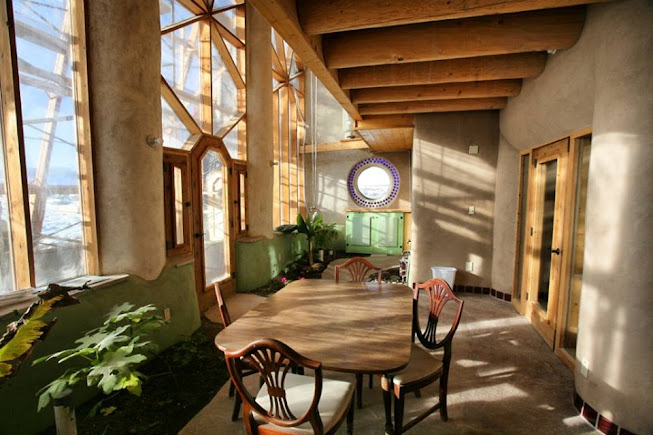
On the south face of the Earthship – or the north face, if it’s being built in the Southern Hemisphere -- Reynolds placed large windows under an overhanging roof, letting the low sun into the house in the winter when it’s most needed, and keeping the high sun out during the summer when it’s needed least. All day, the sun warms the interior walls and floor of the Earthship, which release the heat slowly over the cold night.

Since the front windows act like a greenhouse, most Earthship owners create a garden bed just inside, a mini-greenhouse in which they can plant crops. The plants, in turn, can be supplied with a steady supply of water from the house with wastewater from the shower, bath, or sink. The system acts like a permaculture garden, which I wrote about in this column a few weeks ago – everything is recycled over and over, and nothing is wasted.

The effect of all this is a home that anyone can build themselves, using readily available materials, and that will stand up to time and the elements. Such homes can be fitted for electricity, heat and water pipes, of course, but since they are designed to get maximum light and heat from the sun and typically have rainwater collection, and recycle everything in the house, there is little need for bringing in energy or resources from the outside. If people around the world built using these principles, much of our annual expense on mortgages, heating and food would disappear, as would much of our society’s carbon emissions that are changing the climate.

The Earthship concept grew by word-of-mouth, and now there are Earthships – using very little energy and largely off-the-grid – in almost every state of the U.S. The technique is now expanding into Europe, although might need to be adapted somewhat to a climate like Ireland’s, though would probably need to be built level to the ground rather than under it in this damp country. 

If you are considering building a home yourself, look into the Earthship design – check out Michael Reynolds’ books, Earthship I, II and III, or Google “Earthship,” and consider learning more about this ingenious method. You can also look at a short video about Reynolds at http://www.whatiswaste.com/earthships.


Thursday, 23 December 2021

Father Christmas, homesteader


Hello everyone. As I mentioned, the last couple of years have thrown my life into some chaos, and not just because of the pandemic. Now, however, things have settled down, I’m writing again, and will have original material ready in the new year. In the meantime, have a great Christmas.

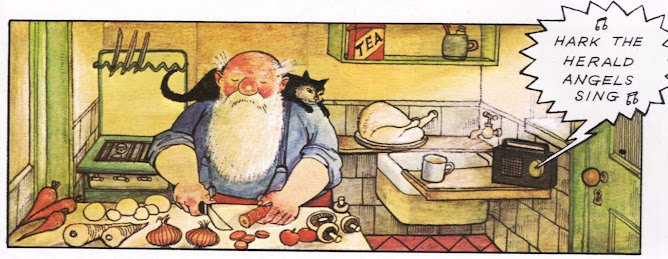
 This time of year, my daughter used to have one favourite story: Raymond Briggs’ Father Christmas, the story of Santa’s rounds on Christmas night. It’s one of my favourites as well, if for different reasons.

In this graphic novel, silent but for a few grumbles and greetings, there is no Ms. Claus, elves or secret toy-industrial complex. Father Christmas, here, is an old man living in apparently contented solitude, dutifully venturing out yearly to make his deliveries. He endures storms, fog, sleet and high winds across the world, complaining the entire way and occasionally strengthening his resolve with a drop of liquor.

Such an unsentimental portrait might sound depressing, but it makes Santa more human, and more comprehensible, than the usual laughing caricature. Briggs makes him a hard-working man performing a service we value; Briggs could easily be showing the daily routine of a miner, a fisherman or a farmer. At one point Santa passes a milkman also making deliveries, and they exchange pleasantries without stopping – and even on Christmas morning, the milkman must make his rounds as well.

What I particularly like, though, is that Santa seems to live on a homestead. He starts his morning gathering hay for the animals, is pleased to find two winter eggs from the chickens, and has breakfast with tea. He stokes the small stove, similar to the one we use to burn our bog turf. You wouldn’t be surprised to see a vegetable garden or greenhouses out back.


The book doesn’t say where he lives, although children here say Santa lives in Lapland – northern Finland --- rather than the North Pole. From the tea to the Christmas pudding, though, it looks like working-class Britain in the mid-20th century, the “deeply conservative land” that David Kynaston shows through contemporary diaries in his impressive Austerity Britain. It’s the Britain G.K. Chesterton or C.S. Lewis might have recognised, the life an old man might have lived in Britain when the book was written in 1973.

Father Christmas and Austerity Britain would seem two very different books, but they both focus on the similar cultures, eras and intimate details of living – supper, chores, schedule. Minutiae like this bring earlier eras to life in a way most histories miss, and offer a casual vision of an austere but civilised world that we might be able to revive, as an alternative to worse futures.

In a small room Father Christmas sleeps under quilts, in long johns, with a hot-water bottle, for heat was precious. The bed-stand looks of rough wood, as though he carved it himself, and on it he keeps his teeth and a wind-up alarm clock. The concept of a carbon footprint was decades away when the book was written, but without adding anything for flying reindeer, Santa’s would be close to zero.

As he makes his rounds, we see English farmhouses by moonlight, and my daughter pointed out the details she recognises --- bicycles, water barrels to catch rain from gutters, sticks crossed in the garden for peas to climb. Sometimes Santa has to crawl out of the stove, for people cooked with wood or coal and the oven went to the chimney.


That world was already fading when Father Christmas was published in 1973, and the encroaching modern world seems to confuse Santa. He struggles to find entry into a caravan – a trailer or mobile home to Americans – and he gets tangled in someone’s television antenna. We wondered about things like this as children -- how many of us had ever seen a home with a chimney, much less a sleigh?

The whole story, of course, made more sense when it was gaining popularity in the 19th and early 20th centuries; most children were familiar with sleighs or lumps of coal, and hung their stockings by the chimney anyway, to dry. The oranges we received in our stockings were meaningless to us in the 1970s but precious to our forebears; they were from exotic lands. In “A Visit From St. Nicholas,” Mama was in her kerchief and I in my cap because the houses were cold. Children a century ago would not have found such verses cryptic, any more than they would stables and mangers.

Today it might seem like that world has been completely forgotten. As we inched up the energy needle, our mainstream culture abandoned most of its traditional holidays -- Midsummer, Candlemas, Twelfth Night, May Day and many more – and swelled Christmas from a night to a shopping “season.” Christmas movies and television increasingly portrays Santa’s “workshop” as an assembly line, while news pundits annually track the spending numbers like telethon hosts.

Yet people can’t completely forget a more traditional world this time of year, not amid so many traditions. It is at this time of year that modern people are most likely to visit family, cook food, meet their neighbours, go to church, bring greenery inside, go from house to house singing, or even watch black-and-white movies from the simpler foothills of the energy needle.

When we take pleasure in these things, we peek through cracks in the wall of stress and excess and see another, older world on the other side, and realise that it too can bring comfort and joy.

Thursday, 7 January 2021

Published at Grit Magazine, Front Porch Republic


Happy New Year, everyone! To all my American friends and family, I'm sorry about the current upheaval, and after everything we've been through, I hope we all get a lull in the Long Emergency to let us regroup and prepare for the next round.  

Ireland rang in the New Year by going back into its third total lockdown. On the good side, this monastic interlude has taught me to be grateful for my friends and family, and to find joy in simple moments, and to not forget them so easily; I walked around an empty Dublin this morning, watching the dawn light ripple across the river, listening to Haydn's magnificent 45th Symphony and the lovely prose of the book "My Father's Wake," both of which I recommend.

 I'm delighted to report that Grit Magazine has published my piece on St. Necklace Day, which you can see here

Also, the amazing publication Front Porch Republic, which you should really check out, has published my article on the end of children's games. Check it out here.

Monday, 25 May 2020

Epidemics in the old days

I talked to my neighbour, Angela, about what it was like during the tuberculosis epidemic of the 1950s.

Saturday, 9 May 2020

Covid's Metamorphoses

A few weeks ago, I posted a video about the silver linings to this crisis and quarantine. Now that countries are either opening up or announcing plans to do so, I wanted to make another video looking back on what we've learned from this. Enjoy -- and if you do enjoy it, I'd appreciate it if you subscribed and shared it with all your friends. 


Friday, 3 April 2020

Remembering the pandemics that came before

Recently I was able to interview another one of my elderly neighbours -- by phone this time -- and he told me all about the dangers of tuberculosis in Ireland in the 1950s, along with the Spanish Flu of 1918. We forget how fortunate we are.


Sunday, 22 March 2020

Relaxing during a pandemic


This covers some of the same ground as the article, but I'm hoping people find it useful. Stay safe everyone!
https://www.youtube.com/watch?v=yCMXz8FXABU&t=5s

Tuesday, 25 February 2020

Article published in American Conservative


For those who haven't yet been informed, most of my articles are not moving to the new web site and host of my ongoing projects, Old School School. I'll continue to update this site periodically.

Also, the American Conservative published my breakdown of the Irish election and the rise of Sinn Fein as our newest political force - read all about it here.

I'm continuing to interview elderly Irish about traditional ways of life: you can read the latest part of my interview with Jack here, talking about keeping cows and horses. 

I've also published my interview with my neighbour Angela, talking about a traditional childhood -- you can watch it here.

Finally, Mother Earth News has published my piece on preserving butter in an Irish bog - you can read the article here, watch the video here, and see the piece about it on British television here. It's an hour long, but my piece is mentioned around the 5:45 mark.


Saturday, 28 September 2019

Bog butter


I have a new project I'll be announcing soon, but first: I mentioned a while ago that the BBC programme QI, former hosted by Stephen Fry and now by Sandi Toksvig, will be featuring my bog butter experiment on the show. With that in mind, I thought I'd rewrite and extend this piece a bit. 

When most people picture Ireland, they picture green fields and old stone walls, and that’s true of some places. Ireland also has lots of bog, though – the Bog of Allen, where we live, stretches almost a thousand square kilometres across several counties. Bogs are difficult to get through – they have few roads or villages even today – so they could be isolated, mysterious places, where characters in folktales met giants and fairies, a place where a starving and subjugated people could hide, or hide things.

A bog is a natural wetland, like a swamp or marsh – the difference is that the water is very acidic, so most kinds of plants can’t grow there – but peat moss does very well. Vast areas get covered in peat moss, and as layers of moss die off new layers grow over them, so you get gradually thickening layers of organic matter. In most circumstances it would just decay and become soil, like most things that die – but it’s soaking in dark, acidic water where fungi, insects, even most bacteria can’t survive, so it doesn’t decompose.

Over thousands of years it gets squeezed into a dark red solid called peat, or “turf” here in Ireland. For centuries this was the main fuel here, and kept many a potato farmer warm on a chill evening. That’s why this canal was built in the 1700s – turf was strip-mined from the bog, dried, loaded on carts, pulled by donkeys on these rails, and loaded here on barges to be brought to warm the houses of Dublin. The history and future of turf as a source of energy deserves its own video, but the point here is: Dead things buried in the bog don’t rot, so it’s an ideal place to store things.

People around here still fish out trees that fell in centuries ago and carve their wood into ornaments; the bog-water stained the wood almost black, but it’s still wood. Turf-cutters here find human bodies sacrificed by Druids thousands of years ago, their skins blackened and cured like leather but with their faces still recognisable. This might have been the inspiration for the dead marshes in Lord of the Rings, where you could still see the bodies of the dead under the water.

So people dig up many things from the past in the bog and meant to come back for -- necklaces, coins, tools, swords, 1,200-year-old prayer-books. And sometimes they find stores of food, up to 3,000 years old and not only intact, but edible. Specifically, they find butter.

Bizarre as that sounds, more than 430 caches of butter have been found in the bog, some small as fists, some big as barrels. The aforementioned 3,000-year-old butter weighed more than 35 kilos, the size of a child. And many of the apparently very adventurers discoverers any such discoveries have been eaten, and were reported to be delicious.

This doesn’t even count all the buried gastronomic treasure still waiting out there. Since we can suppose that people buried their butter to unearth and eat it later, and usually did so, these hundreds of finds must represent the small proportion of times that their owners died or the locations forgotten. This must have been a rather commonplace activity.

So why butter, you ask? A surprising number of foods around the world are preserved by being buried in the ground, but they are usually dried foods in arid climates (cheese in Italy), or sub-Arctic countries where the ground is freezing (salmon in Sweden), or where the food is meant to ferment in some way (eggs in China). In this case it’s waterlogged ground, it would probably disintegrate in the water over time unless it’s naturally waterproof, like fat.

This might have been done with meat as well; Archaeologist Daniel C. Fisher buried various meats in a frozen pond and a peat bog for comparison, and found that after a year, the meat buried in the bog had no more bacteria than the frozen meat. If this sounds gross, keep in mind that fast-food burger you last ate might have been more than a year old.  

Also, butter makes a valuable and high-calorie food for poor agrarian people; with it you can fry food or preserve things like potted meats. It was also taxed in medieval times, so burying it could have been a kind of tax evasion.

The constantly-cold Irish bog would keep the butter solid, and it would only age like cheese; in fact, the one taste-tested by Irish schoolchildren was said to taste like well-aged cheese. Some people might simply have liked the taste.

I like to experiment with old ways of preserving food; I learned how to preserve fruit over winter, how to preserve eggs in lime-water or isinglass, how to pickle vegetables or learn which mushrooms are edible. But in all those things I had people around to show me; lots of my older neighbours still make their own jam or wine. I don’t know of anyone who’s ever tried this who could show me how. Thankfully, it’s pretty straightforward – all you need is to access to one of the world’s peat bogs, and I happen to live in the middle of one.  

My daughter and I made some butter at home, which anyone can do; you just pour milk and cream into a jar, put on some music and start shaking. We couldn’t fill it more than a quarter full or we would just get whipped cream, so we had to do this many times to get the three pounds . At some point the sound of the sloshing changes, and you get a solid clump of butter in the middle of the liquid. Traditionally Irish housewives would pat the butter dry of its remaining liquids, but we simply clarified it. 

Then we froze it to keep it solid, wrapped it in cheesecloth and a rope, walked about ten minutes from our house into the bog. I paced the steps first in one direction and then another to make sure I would remember the spot, and tied the rope to a nearby tree to I could find it again.

Seventeen months later we dug up the butter, and while the picture looks pretty disgusting, once we washed it off and unwrapped it the butter looked much the same – a little darker yellow and with an earthy smell, but not rancid.  

The taste was similar – recognizably butter, with a slightly earthy, cheesy flavour a bit like parmesan; it was particularly good over popcorn. It wasn’t something most modern people would choose to eat regularly, but for people who faced periodic famines, it was an ideal store for lean times.

Of course, this butter was only in the bog for 17 months, and the effects are probably very different over 3,000 years. So I’m burying more butter for a longer period of time – dozens of kilos -- and planning to unearth it in about three to five years, some further down the road. If anyone wants to buy some in advance, you can be one of the few people in the world who can say they had this ancient food.