Wednesday, 4 May 2022

What it means to have children


We devote much of our lives to our children, the messages we send to the future we will never see.  

If you walk through a city today, almost everything you see around you was conceived, designed, forged, shaped, fit and lain almost exclusively by married men trying to feed their wives and children, or by single men trying to earn enough money to attract women for sex and children. Without children, there's no point in working hard, or defending one's country, or avoiding addiction, or living.

People who do succeed in having children, though, shape everything in their lives around them. They pay mortgages, not because adults need a house, but so the children can have a yard to play in. They pay high prices for certain neighbourhoods, not because they need it themselves, but because they want to send their children to good schools. They plan holidays around their kids’ schedule. They keep healthy, resisting the temptations of the world, so that they remain with their children as long as possible.

We spend every evening reading to our children, taking walks with them, bringing them along as we check on the elderly neighbours or pick up roadside trash. We take them with us through our lives, but more than that, we change our lives for them. We aspire to become what our three-year-old sees when they look at us, and their gaze makes us better people.

For most of history, people also taught their children what they needed to know to live – hunting, farming, the family trade – expecting life in their children’s age to be much as theirs had been. For recent generations across much of the world, though, this has changed completely – as the fossil fuel boom transformed the landscape, parents assumed life in the future would be very, very different, and for a while they have been right. Old professions – farmer, cobbler, mason, miller, wright – became mere surnames and vanished from census records. The skills themselves disappeared almost completely, as parents did not pass on what they thought would be obsolete.

Our children might face a world moving in the opposite direction. We have a world powered by fossil fuels that will not last forever, dependent on a stable climate that is swiftly growing chaotic, financially dependent on global trade and debt that is becoming unsustainable, and accustomed to peace and cheap goods whose days are numbered. Technology may continue to develop, but there might be less industry to build it, less energy to run it and less money to pay for it.

Most people I talk to -- farmers, construction workers, taxi drivers -- understand that there is an ecological and economic crisis, even if they don't understand all the details. Most people also have children. Yet web sites and publications that discuss the environment or the economy rarely talk about children, and how to train them to deal with the world we anticipate, and most environmental activists I know have a strange absence of children.

It doesn’t help that we’re not sure what to prepare them for. Should we teach them how to write resumes and operate software to thrive in the businesses that exist today, or will they no longer exist a few decades from now? Should we teach them bushcraft skills to survive in the wild, or will those be useless standing in the unemployment line? We could teach them the old skills of farming and village crafts, but we don’t know for certain what crafts will make a comeback – and they would have to practice them while still making a living in the present-day world of suburbs and office complexes, which does not have a ready market for farriers and cobblers.

The best solution is probably to teach them the broad basics, and let them develop more specialized skills as interest and opportunities allow. We can’t second-guess the world, but we can give them the fundamental knowledge and attitude to react to a wide spectrum of unforeseen events. If you home-school, you can turn these into full courses – but even if you send them to a conventional school, you can continue to teach, talk and explore while making supper, driving or reading bedtime stories.

Take, for example, cooking. Amazingly, more than half of all Americans don’t cook anything that didn’t come out of a package, and I don’t imagine Ireland is vastly different. Show them how to put meals together with the basic trinity of vegetables, starch and protein. Show them how to sautee onions, blanch beans, sear meat and make salad dressing. They don’t have to become a master chef – they just have to cook healthy things they like.

Introduce them to growing things. Let them put beans on wet paper towels and watch them grow into sprouts. Have them plant seeds in a cup, and watch them check it day after day as it becomes cress. Take them into the garden as you check the plants for disease, prune the trees, weed the soil. Enlist their help; as Irish farmer John Seymour put it, there are few greater threats to caterpillars than a well-motivated three-year-old.

Teach them to forage, to pick flowers and shoots from fields in spring and fruits and nuts from trees in the fall. Most kids are fascinated by animals, and even unbidden would hunt for crayfish or snails like Easter eggs.

Show them how to turn one food into another – milk becomes yogurt, fruit can be dried for snacks, vegetables can be pickled. To a child, there are few things more fun than pounding and playing with bread dough. To an adult, there are few things more entertaining than their look of astonishment when you uncover the hidden dough and it’s twice as large as before.

Remember that children find their own routine normal, no matter how we feel about it, and they learn things not because we think they are important, but because we repeat them over and over. Make the lessons into song lyrics, set to some catchy tune they like. Make lessons into a game or a contest.

Read to them. I’m astonished at the number of parents who give their children phones or tablets, or let them play video games, often without even checking what they watch. Children don’t need to learn computer games or the latest programmes, but they do need to read, and see you reading. Nor do they need to read books just for children, many of which were created just as consumer products and not as literature. A few centuries ago children grew up reading complex adult material at very young ages, and yours can too.

When they are old enough, show them how money works. Most or our forebears kept their private parts private, but parents taught their children how to manage money wisely; today, almost nothing is embarrassing or forbidden except money. Most people I know were never taught now to do their taxes, estimate an appropriate salary or choose the right products when shopping, but if you teach your child these things, they will have an edge over most of their peers.

Demonstrate that take-out food can be made more quickly at home, for a fraction of the price. Introduce them to compound interest – lend them money at five percent interest per day, and show them how their debt doubles in a fortnight. Later, when they are old enough to have credit cards and mortgages – if such things exist -- they might remember.

Introduce them cheerfully to the notion that accidents happen, things break and the centre does not hold. It probably won’t happen, and there’s no point worrying, but we’d best know what to do just in case. My four-year-old helped me pack an emergency bag, and we recited like a nursery rhyme the items we needed: If it rains we have ponchos, masks if there’s smoke. This filters the water if pipes ever broke. 

The older they get, the more they should learn how the world is connected. This new gadget all your friends have – where was it made? What is that country like? How much energy does it take to ship it here? How long does it last? You might not want to introduce them to too much global tragedy too early, of course, but older children might like the opportunity to solve a mystery, and would take more seriously a conclusion they’ve reached on their own. I used to be an investigative reporter, and think everyone should be one, just for a little while – it should be a year-long course for teenagers.

Let them be curious. If they ask you questions whose answer you don’t know, be careful not to dismiss them or make something up – no parent thinks they would ever do that, but we all get busy and distracted. Admit you don’t know and look it up, or teach them to do so. Don’t let them accept Wikipedia or Google’s first entry. Demonstrate that there’s nothing wrong with not knowing the answer, and there’s something very right about asking the question.

Bring them along. Let them see you shovel an elderly neighbour’s walkway of snow, help build a community garden at the local church, buy second-hand clothes, split a bulk-food order with co-op members, speak at City Council meetings. Know that these things, too, are part of being a good neighbour and good citizen, something that decent people do.

Finally, I try to remember that daughter is not a blog I fill with my own thoughts – she has her own interests and will, and her future is as uncertain as the world's. You can influence them as you influence your spouse, but you’re not going to make them into someone they’re not. Luckily, there are uses for every type of personality, and we will need everyone in the years ahead. Try to make your kids understand that too – we are entering a time when we’ll need each other, and we’re all in this together.

Sunday, 24 April 2022

Drive Easy


If someone discovered the equivalent of a few more Saudi Arabias tomorrow, except the oil wouldn’t cost us anything, you’d think it would break the Internet. It would make screaming headlines in tomorrow’s paper. The same should be true if someone discovered a free way to cut our oil use, which amounts to the same thing.

It would also be a great way to fight climate chaos. As the pollution from our cars and factories gradually fills up the Earth’s atmosphere and traps heat from the sun, it disrupts the normal weather patterns and causing hotter weather in one place, wetter weather in another, and more powerful storms elsewhere. The less fuel we use, the more we slow down the process of climate change to a point that the Earth’s systems of wind and currents can settle back to something like normal.

Imagine if someone found a way to dramatically reduce accidental deaths, increase the lifespan of our cars, save money, and make our neighbourhoods safer. You might imagine everyone talking about this new approach, and every local community proudly adopting it.

We have found a way to do all those things – save fuel, fight climate change, and make us safer, and save money all at once. It’s called driving slowly.
Strangely, though, this simple method gets very little attention: Most drivers assume they can and should hurtle towards their destination at dangerous speeds that devour fuel and money – not just at the speed limit, but 10 kilometres over it.

But the higher your speed, beyond a certain point, the more fuel you use per distance travelled. As Kris DeDecker described in Low-Tech magazine, “air resistance (drag) increases with the square of speed, and therefore the power needed to push an object through air increases with the cube of the velocity … If a car cruising on the highway at 80 km/h requires 30 kilowatts to overcome air drag, that same car will require 240 kilowatts at a speed of 160 km/h …

Thus, a vehicle needs eight times the engine power to reach twice the speed. In principle, this means that fuel consumption will increase fourfold (not eightfold, because the faster vehicle exerts the power only over half the time).”

In other words, travelling half as fast could save you up to 75 percent in fuel costs. Since 60 percent of the world’s oil is used for transportation, if everyone cut their speed in half tomorrow, this would reduce world oil consumption by almost half. Obviously this is theoretical and the world isn’t going to do that tomorrow, but you don’t have to wait for the world before slowing down yourself.

Such a simple equation inevitably has many complications, but none that are fatal to the basic idea. DeDecker does note that today’s cars are unfortunately designed to be maximally efficient at higher speeds, which reduces the 75-percent figure somewhat unless the engines are adjusted – and, in fact, most automotive sources say the best speed is between 50 and 80 km/hr (35-55 miles/hr). It also doesn’t allow for urban congestion and frequent stops – although slower speeds would discourage the unnecessary trips that cause congestion, and make bicycles and taking public transportation a more cost-effective option.

But maybe 75 percent, or whatever figure you can achieve by driving slowly, is not enough – maybe you demand an additional 500-percent increase in efficiency on top of that. There is a way to do that as well: add four more passengers to your car.

Passengers might be the most under-appreciated factor in how much fuel and money you waste. As I write this, for example, a business headline boasts of Toyota’s multi-million-dollar plan to boost fuel efficiency by 25 per cent, with the usual discussion of what this will mean for the economy and the climate. Any of us, however, can boost the efficiency of our cars by several hundred per cent instantly, with no additional expense or technology, simply by getting more people in the car.

This fact is also forgotten when we judge car owners by the wastefulness of their vehicles. An SUV is a spectacularly inefficient machine compared to a Prius, for example, but pack that Dodge Durango full of people and suddenly it is greener than the electric hybrid driven alone. Your bus could be less efficient than an SUV in kilometres-per-litre, yet all of you bus passengers are making one of the greenest transportation choices around, thanks to the fact that so many seats are filled.

According to the website carfinance.ie, the average car in Ireland, driven 10,000 kilometres a year, will cost 1,750 euros in petrol. Divide that by four people, however, and you each save 1,300 a year.

Of course, you might say, such actions are a drop in an ocean. But change comes from thousands of such small actions. It was generally big-budget extravaganzas that got us into the situation we are in; the modest, the tiny and the slow are more likely to get us out.

Friday, 28 January 2022

Earthships


This article originally appeared in the Kildare Nationalist newspaper. 

All of us live in homes that are dependent on larger systems to operate: electrical grids, heating and plumbing. Most of our homes require large amounts of energy to run, which we burn fossil fuels to acquire. We also have all kinds of waste products – tires, soda cans – that fill up landfills, never to be used again.

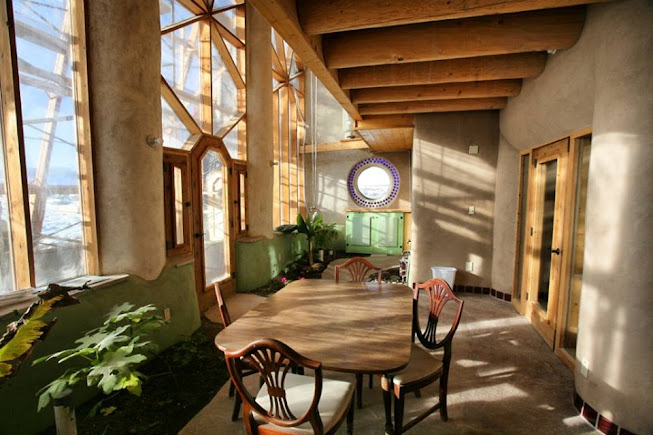
A few decades ago, however, one American began to think through, meticulously, how many of these problems could solve each other. Michael Reynolds called his solution the Earthship, a home built to be as efficient and self-sufficient as possible, using mostly free materials that are either natural or recycled. The Earthship is designed to require as little energy as possible to maintain, to recycle its air and water as much as possible, and to provide food for people inside the house.

In order to keep the temperature as constant as possible, Reynolds planned for his Earthship homes to be surrounded by earth on three sides, usually built into hillsides. As the weight of the surrounding hill would make straight cement walls unstable, Reynolds created walls made of earth-filled tires, curved to allow the hill’s pressure to dissipate around the structure.

Tires turned out to be an inspired choice for building material – there are more than two billion old tires in the world, and they do not biodegrade naturally, so they clutter up landfills. They do hold earth well, however, and a wall of connected tires covered with a plaster can be very sturdy, earthquake-resistant and fire-resistant.

Reynolds also designed the top of the structure to catch rainwater to use for the household, and the buried sides to insulate the house. Other spaces around the front can be made with cement – but Reynolds likes to use old soda cans as filler, to make the structures lighter and to save money buying cement. Another popular technique for Earthships is to use old glass bottles as filler, thus saving mass and cement while also creating insulation – from the air inside the bottle – and creating a small coloured window, all at once.

On the south face of the Earthship – or the north face, if it’s being built in the Southern Hemisphere -- Reynolds placed large windows under an overhanging roof, letting the low sun into the house in the winter when it’s most needed, and keeping the high sun out during the summer when it’s needed least. All day, the sun warms the interior walls and floor of the Earthship, which release the heat slowly over the cold night.

Since the front windows act like a greenhouse, most Earthship owners create a garden bed just inside, a mini-greenhouse in which they can plant crops. The plants, in turn, can be supplied with a steady supply of water from the house with wastewater from the shower, bath, or sink. The system acts like a permaculture garden, which I wrote about in this column a few weeks ago – everything is recycled over and over, and nothing is wasted.

The effect of all this is a home that anyone can build themselves, using readily available materials, and that will stand up to time and the elements. Such homes can be fitted for electricity, heat and water pipes, of course, but since they are designed to get maximum light and heat from the sun and typically have rainwater collection, and recycle everything in the house, there is little need for bringing in energy or resources from the outside. If people around the world built using these principles, much of our annual expense on mortgages, heating and food would disappear, as would much of our society’s carbon emissions that are changing the climate.

The Earthship concept grew by word-of-mouth, and now there are Earthships – using very little energy and largely off-the-grid – in almost every state of the U.S. The technique is now expanding into Europe, although might need to be adapted somewhat to a climate like Ireland’s, though would probably need to be built level to the ground rather than under it in this damp country. 

If you are considering building a home yourself, look into the Earthship design – check out Michael Reynolds’ books, Earthship I, II and III, or Google “Earthship,” and consider learning more about this ingenious method. You can also look at a short video about Reynolds at http://www.whatiswaste.com/earthships.


Thursday, 23 December 2021

Father Christmas, homesteader


Hello everyone. As I mentioned, the last couple of years have thrown my life into some chaos, and not just because of the pandemic. Now, however, things have settled down, I’m writing again, and will have original material ready in the new year. In the meantime, have a great Christmas.

 This time of year, my daughter used to have one favourite story: Raymond Briggs’ Father Christmas, the story of Santa’s rounds on Christmas night. It’s one of my favourites as well, if for different reasons.

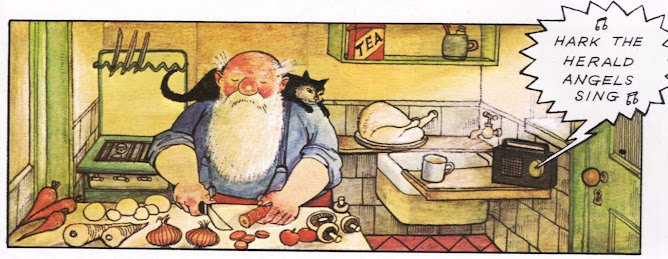
In this graphic novel, silent but for a few grumbles and greetings, there is no Ms. Claus, elves or secret toy-industrial complex. Father Christmas, here, is an old man living in apparently contented solitude, dutifully venturing out yearly to make his deliveries. He endures storms, fog, sleet and high winds across the world, complaining the entire way and occasionally strengthening his resolve with a drop of liquor.

Such an unsentimental portrait might sound depressing, but it makes Santa more human, and more comprehensible, than the usual laughing caricature. Briggs makes him a hard-working man performing a service we value; Briggs could easily be showing the daily routine of a miner, a fisherman or a farmer. At one point Santa passes a milkman also making deliveries, and they exchange pleasantries without stopping – and even on Christmas morning, the milkman must make his rounds as well.

What I particularly like, though, is that Santa seems to live on a homestead. He starts his morning gathering hay for the animals, is pleased to find two winter eggs from the chickens, and has breakfast with tea. He stokes the small stove, similar to the one we use to burn our bog turf. You wouldn’t be surprised to see a vegetable garden or greenhouses out back.


The book doesn’t say where he lives, although children here say Santa lives in Lapland – northern Finland --- rather than the North Pole. From the tea to the Christmas pudding, though, it looks like working-class Britain in the mid-20th century, the “deeply conservative land” that David Kynaston shows through contemporary diaries in his impressive Austerity Britain. It’s the Britain G.K. Chesterton or C.S. Lewis might have recognised, the life an old man might have lived in Britain when the book was written in 1973.

Father Christmas and Austerity Britain would seem two very different books, but they both focus on the similar cultures, eras and intimate details of living – supper, chores, schedule. Minutiae like this bring earlier eras to life in a way most histories miss, and offer a casual vision of an austere but civilised world that we might be able to revive, as an alternative to worse futures.

In a small room Father Christmas sleeps under quilts, in long johns, with a hot-water bottle, for heat was precious. The bed-stand looks of rough wood, as though he carved it himself, and on it he keeps his teeth and a wind-up alarm clock. The concept of a carbon footprint was decades away when the book was written, but without adding anything for flying reindeer, Santa’s would be close to zero.

As he makes his rounds, we see English farmhouses by moonlight, and my daughter pointed out the details she recognises --- bicycles, water barrels to catch rain from gutters, sticks crossed in the garden for peas to climb. Sometimes Santa has to crawl out of the stove, for people cooked with wood or coal and the oven went to the chimney.


That world was already fading when Father Christmas was published in 1973, and the encroaching modern world seems to confuse Santa. He struggles to find entry into a caravan – a trailer or mobile home to Americans – and he gets tangled in someone’s television antenna. We wondered about things like this as children -- how many of us had ever seen a home with a chimney, much less a sleigh?

The whole story, of course, made more sense when it was gaining popularity in the 19th and early 20th centuries; most children were familiar with sleighs or lumps of coal, and hung their stockings by the chimney anyway, to dry. The oranges we received in our stockings were meaningless to us in the 1970s but precious to our forebears; they were from exotic lands. In “A Visit From St. Nicholas,” Mama was in her kerchief and I in my cap because the houses were cold. Children a century ago would not have found such verses cryptic, any more than they would stables and mangers.

Today it might seem like that world has been completely forgotten. As we inched up the energy needle, our mainstream culture abandoned most of its traditional holidays -- Midsummer, Candlemas, Twelfth Night, May Day and many more – and swelled Christmas from a night to a shopping “season.” Christmas movies and television increasingly portrays Santa’s “workshop” as an assembly line, while news pundits annually track the spending numbers like telethon hosts.

Yet people can’t completely forget a more traditional world this time of year, not amid so many traditions. It is at this time of year that modern people are most likely to visit family, cook food, meet their neighbours, go to church, bring greenery inside, go from house to house singing, or even watch black-and-white movies from the simpler foothills of the energy needle.

When we take pleasure in these things, we peek through cracks in the wall of stress and excess and see another, older world on the other side, and realise that it too can bring comfort and joy.

Thursday, 7 January 2021

Published at Grit Magazine, Front Porch Republic


Happy New Year, everyone! To all my American friends and family, I'm sorry about the current upheaval, and after everything we've been through, I hope we all get a lull in the Long Emergency to let us regroup and prepare for the next round.  

Ireland rang in the New Year by going back into its third total lockdown. On the good side, this monastic interlude has taught me to be grateful for my friends and family, and to find joy in simple moments, and to not forget them so easily; I walked around an empty Dublin this morning, watching the dawn light ripple across the river, listening to Haydn's magnificent 45th Symphony and the lovely prose of the book "My Father's Wake," both of which I recommend.

 I'm delighted to report that Grit Magazine has published my piece on St. Necklace Day, which you can see here

Also, the amazing publication Front Porch Republic, which you should really check out, has published my article on the end of children's games. Check it out here.

Monday, 25 May 2020

Epidemics in the old days

I talked to my neighbour, Angela, about what it was like during the tuberculosis epidemic of the 1950s.

Saturday, 9 May 2020

Covid's Metamorphoses

A few weeks ago, I posted a video about the silver linings to this crisis and quarantine. Now that countries are either opening up or announcing plans to do so, I wanted to make another video looking back on what we've learned from this. Enjoy -- and if you do enjoy it, I'd appreciate it if you subscribed and shared it with all your friends.