Monday, 25 March 2013

Faith in the future


This year Catholics enter the most important week of their religious calendar with a new pope, and if you’re like many of my colleagues, this doesn’t mean much to you. I don’t see much writing about religion among the ecologically-minded, perhaps because many are not very religious themselves, or perhaps they are avoiding that most delicate of subjects. I want to make a case, though, that you should care – perhaps about the new pope, and definitely about religion in general – as you make plans for the future.

As a bit of background, you might have heard that the last pope took the unusual step of resigning a few weeks ago; popes usually hold the office until they die, and the last one to willingly step down was more than 700 years ago. The new pope, Francis I, is all kinds of other firsts – the first from the Western Hemisphere, the first from the Southern Hemisphere, the first from outside Europe in 1,300 years, the first from the church’s 500-year-old Jesuit order, and the first to be visited on their inauguration by the head of the Eastern Orthodox Church for almost a thousand years. Unlike some of his predecessors he has been deeply critical of the global financial system that has left so many Third-World countries poor and indebted, and he has impressed observers with many small gestures toward simplicity. 

He now heads a church devastated by massive sexual abuse scandals in several countries, and will have little credibility unless he starts sacking people left and right for covering up those horrific crimes. They were just the most recent blows, however, to an already weakened religious empire.
Most people know something about our clergy and rituals from mass media, for when Central Casting needs someone to be demonically possessed or Whoopi Goldberg to wear a disguise, the Hawaiian shirts of feel-good mega-church pastors just don’t cut it. We represent all things arcane and traditional in Hollywood pop culture, yet that same culture has made those traditions difficult to maintain. Our deliberately paced rituals were not made for a world of ubiquitous iDistractions, or our austere teachings for a world with the comforts and sexual freedom of Egyptian pharaohs.

Recent popes made some small concessions to a rapidly changing world – allowing the Mass to be said in local languages rather than in Latin, for example – but they often just alienated traditionalists, while not making the meaty concessions that many modern Catholics want. If anything the Church has responded to the modern world by forbidding more and more of it; formally opposing abortion in 1869, and contraception from 1930. Pulled and pushed from many directions, a growing number of the world’s billion-or-so Catholics silently question how many catechism points they can disagree with before they need to start calling themselves something else.

Today the world’s largest denomination of the world’s largest religion is undergoing its own kind of slow collapse – not vanishing, but shrinking rapidly in the First World. To use one small but typical statistic, the seminary (school for future priests) near where we live in Ireland ordained 558 priests in 1963 -- a mere 12 entered last year. Catholics in the USA are melting away from the Church en masse, their numbers only partly obscured by a flood of Hispanic immigrants. When I returned to my hometown last year, where I attended junior seminary myself once, I discovered almost all the Catholic schools had closed, and my old church had taken out its cry room for mothers with babies – there hadn’t been any in a long time.  

Some former Catholics I know have become militant atheists of the new breed, who embrace nihilism not with mourning, as Nietzsche or Camus did, but with glee. Others have been caught in the gravitational pull of the USA’s fundamentalist movement, which has spent the last few decades building an extraordinary media empire and absorbing more and more American Christians into its cultural bubble.

Perhaps the oldest surviving organisation on the planet, one that survived the rise and fall of several empires and centuries of hardship, is failing in an age of overabundance, most in the most abundant parts of the world. It needs to decide what kind of church it wants to be as we pass into the next and particularly difficult era ahead. So for Catholics, this is kind of a big deal.

I know, the Church has a lot of shameful history – so does my native USA, or Britain, or France, any other country or organization with a bit of history behind it. Point to the Inquisition and I’ll point to one of your group’s original sins, because there will be some. In each case, though, the past doesn’t necessarily represent the present, nor do the shameful parts negate the brilliant parts, nor do some decisions by a government represent all actions of a people.  I’m embarrassed by some of my countrymen but not ashamed of my country; it’s home to me, and I’m proud of its better angels. Perhaps you have your own example.   

To extend the metaphor, Francis is being greeted by Catholics as Obama was in the USA. He’s a demographic first that seems to reconcile a painful history, made in a time of crisis and potential. As with Obama, however, people are projecting all kinds of hopes and fantasies upon him, and some will inevitably be disappointed when he does not walk on water.

As I said, if you’re not religious, none of this seems very important compared to the years of global crisis we anticipate. We all know that our species is burning away the world’s supply of fossil fuels upon which our economy depends, and disrupting the weather in the process. We know that the living systems that keep the Earth running are seeing one of their periodic mass extinctions – not an asteroid or super-volcano this time, but a single ape species – and we know that past crises didn’t heal on a human timescale. I’m right there with you.

Think about this, though: What if you are trying to work against these trends, and rally others to your cause? What if you are trying to build communities, or change the way people vote, or organise protests? What if you want to assemble communities in the country to become self-sufficient? And what if, hypothetically, your allies hail disproportionately from specific subcultures – tech-savvy, 
 upper-class, coastal, countercultural, socially libertine and irreligious?

We tend to live in bubbles of people like us, and while social media has made it easy for people to have geographically disparate “communities,” I find that most people still communicate mainly with others of the same generation, education, religious and political attitudes. If no one you know goes to church, for example, you might forget that 40 per cent of Americans do, and forget to factor that into your community-building.

Not all people who don’t talk about their faith are nihilists, of course – some just walk rather than talk, and I wish more people did. I’m not a fan of the current fashion in the USA, where oversharing about faith became popular around the same time as oversharing about sex and other private matters. If you want to deal with others in creating a future, however, you must be prepared to deal with the fact that most people believe in something, and that it will not and should not remain tucked away under a basket.

For one thing, religion often deals with the most basic assumptions of one’s life -- the visceral and magical attitudes that underlie our political and religious affiliations. Since we so often refuse to even examine, much less talk about, such attitudes, we often engage in culture wars without talking about the thing we’re really talking about. When an acquaintance of mine said he disagreed with evolution, for example, I politely asked probing questions, and with each answer I was more confused than before. He was intelligent and well-educated, and each sentence was cogent and eloquent – but I didn’t see their relationship to the subject or each other.

The problem was that he began from the assumption that evolution was what some atheists think it is, an anti-religion religion that evangelises a meaningless existence. I, however, was referring to the evolution that scientists study -- the way that living things change over time. (I know Richard Dawkins falls into both camps, but most scientists I know don’t.) You could replace the word “evolution” with “existentialism” and his answers would be much the same: Evolution can’t explain everything. Evolution doesn’t comfort you in grief. Evolution won’t save you when you die.

You could replace “evolution” with “digestion” or “precipitation,” however, and they would have made about as much sense to me. Does digestion explain everything? Does precipitation comfort us in grief? Or, if we’re talking more about the history than the process, replace the word with any historical event: does the Moon landing address the problem of evil? Can the Civil War explain everything?

Religious beliefs include, or are influenced by, such baseline assumptions, and much of their jargon exists to separate people inside the group from outside. When someone asks me if I’ve accepted Jesus as my “personal saviour,” or insists they are “just Christian” of no particular type, it gives me a clear idea what type of Christian they are.

Neglecting such a powerful force in our lives, or its absence, prevents us from seeing their effect on the political and social landscape – and how they are affected by it. Take, as an example, the early 20th-century debate between pre-millennials and post-millennials – which has nothing to do with people born around the year 2000, and everything to do with how we think of the future. To oversimplify, post-millennials believe humans could and should make the world suitable for Christ before he returns, whether it be the Puritans’ idea of suitable or Martin Luther King’s. Either way they tend to be optimistic and ambitious in creating social change – in King’s words, “the arc of the universe … bends toward justice.”

Pre-millennials, on the other hand, believe that the world will get worse and worse before the Second Coming, and their visions lean toward fatalistic, Zombie Apocalypse territory – when you hear about “The Tribulation” and “The Rapture,” it’s probably from a pre-millennial.

It might not be a coincidence that the two seem to rise and fall with the fortunes of a country. In the early 19th century, as the USA headed closer to civil war, pre-millennial movements like the Millerites spread across the then-frontier, hailing the end of the world until the “Great Disappointment” of 1844. As the Millerites fragmented into many other groups – that’s where Seventh-Day Adventists and Jehovah’s Witnesses come from – post-millennialism seemed to gain steam, and their idealistic movements helped abolish slavery, invent labour rights and give women the vote.

As the USA became the dominant global power, post-millennial churches remained powerful through the civil rights movement. Then, as the country passed its domestic oil peak and the public grew aware of ecological dangers ahead, an ecological-sounding book called The Late Great Planet Earth became a runaway hit – it’s often claimed to be the best-selling book of the decade. That book inspired a growing pre-millennial movement among the young and countercultural, which evolved into the nationalistic and somewhat paranoid fundamentalism so influential in the USA now. 

You’ll notice, though, that both of these strains of Christianity pretty well parallel the two visions of the future popular in the fossil-fuel era. In the mid-20th century, when Westerners saw rapid technological and social progress, the gospel of progress affected not just religion, but politics and science. Evolution was reframed as the ascent of Man, my country’s expansion reframed as Manifest Destiny, history as the March of Progress. When my country’s tables turned in the 1970s, not only did the religion get apocalyptic, but politics and popular culture did too.

Whether the religion led or followed the other trends is difficult to say, and of course not everything falls into these neat categories – apocalyptic thinking was around long before the first oil well – but their popularity does seem to rise and fall with energy inputs. If this pattern holds, we might expect to see pre-millennialism – what I’m calling “fundamentalism” - continue to be one of the few things that boom as fossil fuels decline.

That could be very bad news for the rest of us if they persist in attacking basic science education in my own country, because of their aforementioned ideas about evolution. People can have their own opinions about gay marriage or abortion – there are good people on all sides of these issues, and we can sort out our differences democratically. We can also have respectful differences about our faith in the unproven. We do not, however, have to respect someone’s faith in the disproven, and a generation without science education is the last thing we need as we enter an ecological crisis.

On the other hand, I’m throwing around terms like fundamentalist, evangelical and mega-church as though they were interchangeable, and of course there are many divisions and nuances. I know many fundamentalists who would make bitter flame-war enemies online but great neighbours in a real-world crisis. I also know others whose faith has inspired them to adopt a more traditional way of life – and in doing so pave the way for the rest of us. Also, many groups settle down over time, or we soften toward them; we don’t think of the “Salvation Army” as being a genuine army, say, getting into shooting wars with gangs, but once they were and did.

None of those religious groups, though, completely abandoned their belief in progress, and these days most people across the political and religious map tend to celebrate progress in some area – whether it be newly broken cultural taboos or newly vaulted Dow numbers. Most people I know, of any political or religious group, feel perfectly comfortable questioning their opponents’ version of progress, but respond indignantly to any questioning of their own version.

Of course we have progressed -- few humans have experienced our level of comfort and freedom, our health or literacy. We live in an age when humans live eight decades, and with a few touches of a finger can connect to the wisdom of the world. Yet most of those changes exist because of fossil fuels and the technology they allow; that cheap-energy window appears like a needle along the timeline of humanity, and as we pass over one peak after another we need to think about what parts of progress are objectively right and necessary for our descendants. Nor has the freedom to choose every aspect of our lives necessarily made us happier, as far as such things can be measured, than people who did not have such choices.

The myth of progress also doesn’t allow us to say no. It assumes that if a little of something was a relief to oppressed or impoverished ancestors -- wealth, choices, entertainment, anything – that we have to keep following that trend forever. It doesn’t allow us to stand astride history yelling “Stop!” It doesn’t let us say when we’ve had enough, even when the enough we have is temporary. That’s what religions are supposed to do.  

Religions done rightly – which usually means traditions that pre-date the cheap energy window –go against today’s left and right alike, and violate every value we learned from generations of stump speeches, motivational seminars and Disney movies. They don’t tell you that you should always follow your heart, or that you are destined for greatness, or have a right to choose whatever path you 
want, or that everything will work out all right in the end.

It tells you that you are frail and flawed, here only briefly, that your problems are not very different than everyone else’s, and that we are all in this together. They give our mayfly lives an umbilical cord to eternity – and even if you don’t believe that happens on a spiritual level, the tradition does in this world. There aren’t many institutions that allow us to cite the centuries of the second paragraph, or whose still-standing monasteries kept learning alive through the end of the Roman Empire.  

Now another empire is declining – the USA specifically, and the globalised consumer culture in general. In Walter Miller’s novel A Canticle for Liebowitz, a group of Catholic monks preserve the bits of Western Civilisation after a nuclear war, sometimes without understanding it, until the world is ready for it again. The real collapse will probably not be as dramatic as a thermonuclear exchange that seemed so imminent when it was written five decades ago, of course. It will likely be more of the small crashes and crises we have seen in the last decade, giving us a bit of space to do something like the monks of the novel – or the real ones fifteen centuries ago, whose ruins dot the fields around us.

So let’s say you want to help your descendants transition into as humane and civilised an existence as possible, even though you won’t be around to see it. You want to teach children to live a more sustainable life of less consumption and energy use, even when a million distractions around them tell them to do otherwise. To live out this vow of poverty you might need to encourage them to withdraw from the world, as St. Benedict did long ago, and build a community of people who believe the same. You will need to inculcate strict code of restraint in your congregation, and teach a set of rituals that will help people succeed at this new life.

There – you’ve just become religious. Whatever your opinions about the supernatural, you have a set of traditions, rituals and values that sustain you through hardship. There are many traditions you can draw from, of course – I have mine.

Perhaps you have your own example.   


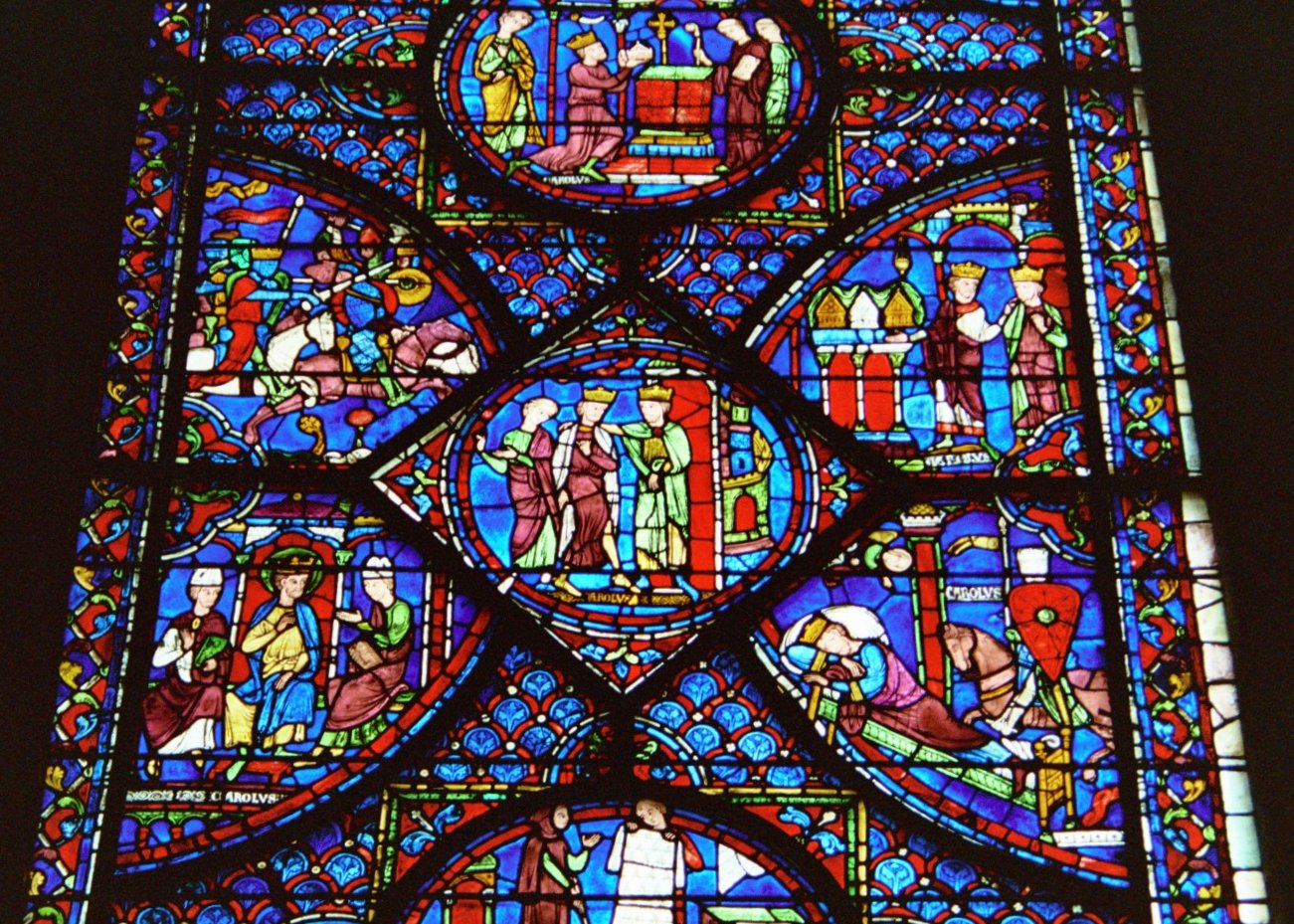
Top photo: Window of Chartres, courtesy of Wikicommons. 
Second photo: Priests emerging from the seminary at Maynooth near our home.
Third photo: Priest blessing a gardai (policeman) in Ireland. Both these photos seem to be from around the 1930s and are used with permission from Irishhistorylinks.com.
Fourth photo: The graveyard at Glendalough, a monastery built in the 500s. 
Final photo: The stream at Glendalough.

Thursday, 14 March 2013

Country children

"I pity the country children of today. The journeys to and from school were an education as valuable as any we managed to imbibe at school. We had to trudge about three miles over little white limestone roads and through what was known as ‘mass paths’ through the fields to reach our school."

"… Setting out from home on sun-filled mornings with the nip in the air. I don’t remember any rainy September days, only the hazy light on the changing leaves. In my mind’s eye I can still see the jewelled cobwebs steteched between the blackberry fronds."

"I can remember the taste of ripe damsons and blackberries and hazelnuts which we cropped on our long journey homeward on autumn evenings. Cobwebs with dew, distant sounds of threshers, blackberries and hazelnuts gathered on the way. There were hazards too, like the eve of fair day when dealers’ wild horses were on the road."

-- Nancy Power, Redestown, County Kilkenny, 1920s 

“…we didn’t walk through fields to school, but travelled the then rugged and stony way which was uphill and down dales … no (paved) roads in those days of sparse cash but healthy living. Making ourselves happy with very little was the norm for us all."

"Those times were known as the ‘hungry thirties,’ which I think is a misnomer because there was plenty of home-produced natural food available everywhere and those that hadn’t it shared it with their neighbours."

"Walking to school, we stopped to look in birds’ nests, picked wildflowers to bring for the altar, pass herons, frogs, water-hens and a millwheel then in use, a maid putting out their cows after milking and a ploughman urging on his horses. At school we learned arithmetic by counting snails. We remembered a rat and his mate having a row, a white-horn in full bloom."

--  Bessie Byrne Sheridan, Askamore, County Wexford, 1930s

Both quotes from the compilation No Shoes in Summer, Wolfhound Press. Photo from Irishhistorylinks.com. 

Monday, 25 February 2013

Old mill

The Girl and I, with some friends from my non-profit, journeyed south to Kilkenny some time ago tour places that were using sustainable energy. We looked at a community for the mentally handicapped that used a bio-digester to make heat and electricity, as well as a factory that used a waterwheel.

Along the way, though, we also saw this old mill, now an ivy-covered skeleton. It reminded us that sustainable power is not a hip new fashion. Virtually all energy used was once sustainable, whether it be from the muscles we replenish by eating or the wood we can regrow, from sailing ships to waterwheels. Almost all the energy we used to fashion our lives came from our world's daily energy salary, before we discovered a trust fund under our feet.

I expect we will restore a world of water mills world one day, but I would like to see us do it comfortably, while resources are plentiful, rather than in haphazard desperation.

Wednesday, 20 February 2013

Storytellers


I interviewed an elderly couple some months ago, and they described they way they and their neighbours passed the long evenings.

"... people would visit each other’s houses and have dances, and do the reels and the Irish dancing. and the women would drink tea and the men would drink porter. And they would have a seanchai – a storyteller – and he’d be spinning great yarns and tales, some of them the old, old stories. 

Some of them might be two thousand years old, really stories from prehistory -- stories of Kilcullen and Meave, stories from long long ago. Seanchas is the Irish word for old, so a seanchai (shawn-a-kee, they pronounced it) was telling the old stories.

[We had a] turf fire, very warm, and the people gathered around listening to the seanchai telling his story. A lot of ghost stories, as the Irish are really into ghost stories. And the children were supposed to go to bed but were allowed to stay up, and would listen to the seanchai, their eyes wide like saucers."  

Photo: a storyteller on fair day. Courtesy  of Irishhistorylinks.com.


Friday, 15 February 2013

First daffodils

February in Ireland does feel like slowly emerging from a tunnel, as the deep darkness of the long subarctic nights slowly recedes, and our early morning and late evening bus rides see sunlight again.

The gothic landscape slowly takes on a slightly less grim appearance in the cold grey light, and in the bogfields around us, great ponds slowly retreat into greenery.

Here and there below the trees, the squishy underfloor breaks open like an egg, and the first flowers appear, racing to build a bulb beneath them before the trees above them bud and the ground grows dark again.

Wednesday, 13 February 2013

Ash Wednesday


Catholic or not, we all need something like Ash Wednesday in our lives, something to remind us that we are not gods of infinite potential, but flawed and funny creatures in our brief days in this world.

Thursday, 7 February 2013

The old butcher

The village near our house is basically an intersection, with little besides a pub, a church and a petrol station -- but it does have a butcher, as does almost every village here. As expensive as meat can be, it was all the more prized when people were poor and communities were more self-reliant.

Village butchers were highly valued for centuries. In their 1816 book "The Experienced Butcher," James Plumptre and Thomas Lantaffe wrote that "...you want to seek cleanliness and civility, the greatest recommendations of a tradesman, and no more than butchers. The real nature of their business and the prejudices of the world make these qualities more particularly requisite in them."

I was listening to one of Radio Televis Eireann's archives the other day, hearing an interview from a quarter-century ago with butcher Thomas Kieron, then-owner of a shop in a small town in rural Ireland. He complained that they could no longer put pigs-heads in the windows, as it would frighten customers -- "People cannot tolerate the idea of what they are eating," he said, "yet they can turn on the telly and watch people getting blown up... I find it most peculiar."

When asked about the then-new trend for health foods, though, the local butcher really got his dander up.

"And now people have the audacity to start talking this rubbish about other foods being better," Kieron said. "Where could you get a simpler, more straightforward meal than a bit of meat, potatoes and vegetables from the farm, cooked perfectly for your children. What about all the people who are said to be so beautiful today, slipping into Christian Dior dresses? Not all their own weight, but a fraction, so they can wear underwear. And you have this lady, nice and slim, but what happens if she gets a little dose of pleurisy or pneumonia? How can she lose a few pounds weight? She'd be in a shroud. You have to have a bit of meat on you."

Photo of a Dublin butcher in 1946. Courtesy of Irishhistorylinks.com. 

Tuesday, 29 January 2013

Against breakfast cereal

Since few things are more basic than food, it is heartening to see adjectives, like local, slow, organic and free-range creep into mainstream vocabulary. They don’t always come with a full understanding of the issues behind them – I have yet to hear a celebrity chef discuss Ghawar or methane clathrates – but at least the media culture seems to be moving in the right direction. There is one meal, however, that rarely comes up, in which most people continue to eat highly processed and unsustainable food – breakfast.

Here in Ireland, we eat more breakfast cereal per person than any other people in the world, and 95 percent of us buy breakfast cereal each year. According to Kellogg’s web site, the Irish eat more than eight kilos of breakfast cereal per year, two kilos more than in the UK or the USA, making the cereal aisle one of the most visited in the supermarket.

Cereal is the supermarket’s third most popular product in dollars, just behind soda and milk and just above cigarettes. The few corporations that make almost all cereal brands spend more money on advertising than does any other industry except cars.

Most of us grew up eating cereal every morning, possibly featuring one of the more than 1,000 cartoon characters designed solely to sell breakfast products. As adults, many of us continue to eat cereal, told that it is necessary to get vitamins or lose weight.
In fact, breakfast cereals are rarely healthy and never necessary. Most children’s cereal have far more sugar than any child needs – Smacks, for example, are more than half sugar. Even the less saccharine adult cereals are exorbitantly expensive for the amount of nutrition they contain.

When you think about it, a breakfast cereal is a bizarre product -- there is nothing natural or normal about eating manufactured flakes and puffs created by giant machines in factories, shipped around the world and sealed in plastic for months.

It’s probably not a coincidence that they were invented as the world was beginning to use fossil fuels in the 19th century. Fossil fuels allowed more food and a population explosion, fewer jobs on increasingly mechanised farms, and more jobs in increasingly polluted and overcrowded cities. Much of the new mass-produced food for urban workers was of low quality and questionable origin – according to author Otto Bettman, the New York Council of Hygiene reported in 1869 that the meat and poultry hung raw in stores “undergo spontaneous deterioration...becoming absolutely poisonous.” To use another example, city inspectors in 1902 found the majority of milk sold in New York was unsafe to drink.

Understandably, this combination of pollution, overcrowding, stress and near—poisonous food created many stomach problems, and the early industrial era also created a new moneyed middle class that could pay for cures. The first health food movement sprang up in response, with a mixture of common-sense advice, ridiculous junk science and competitive marketing familiar to most of us today. Health gurus touted the 19th-century equivalents of Echinacea or Goji berries, and one solution – made possible by the new industry and mass production – was breakfast cereal.

It wasn’t the only such solution – on this side of the Atlantic, it was cookies that were touted as indigestion cures, and they are still called “digestive biscuits” today. In America, though, health companies touted wheat flakes, and after decades of advertising they became normal and spread across the Western World.

It should be fairly easy to see that cereal cannot continue to be a part of people’s lives much longer: as energy and money grow tight, we will not be able to continue transporting wheat around the world and sending it through energy-intensive factories to be crushed, soaked, pressed and heated. We will have to do more traditional things with grain -- grinding into flour, sprouting, boiling – that served people before the energy window.

Finding out whether cereal is actually “part of a nutritious breakfast” is actually a simple process: Take the nutrition and price of a box of cereal, and compare it to a vegetable like kale.

Take as an example a common adult cereal I chose from the store. One serving of it is 31 grams for some reason, and contains 117 calories, but only 15 percent of your recommended daily dose of Vitamin A and 35 percent of Vitamin C. At my local grocery store, it is 5.49 euros, or 34 cents per serving.

A serving of kale is a lot more food – 130 grams – but has less than a third as many calories, at 36, and has 354 percent of your needed Vitamin A, 89 percent of Vitamin C, plus Calcium and iron, all for seven cents a serving. In other words, kale costs 79 percent less than breakfast cereal and 66 percent fewer calories, but has 2.5 times more Vitamin C and 24 times more Vitamin A.

Of course, that’s just one example: You can’t live on kale alone, nor would it be filling by itself, so scramble it with eggs and eat it with toast. Put it in bean soup. You use your imagination, and you get to practice cooking. If cooking is too much work first thing in the morning, you could make a nutritious meal the night before, and put it in the refrigerator along with your lunch. If you feel like being very organized, you could cook earlier in the week and make enough for breakfast and lunches all day. Finally, you could grow or raise all the ingredients yourself, in your garden, and get your food virtually free.

This seems a small thing, but all that cereal purchased means that it is part of the daily ritual for hundreds of millions of people, and we love our rituals – especially in the morning. Changing them creates stress, and the more changes we have to make at once, the more overwhelmed we will feel. We will be better off eliminating such unnecessary habits now, so that when major changes are forced upon us, our lives can continue as smoothly as possible.

Wednesday, 2 January 2013

Stile in the wall

To paraphrase Waterford farmer John Seymour, other animals outweigh us or can outrun us, or have sharper teeth or more resistance to pain. Our advantage is that we can build a wall that we can pass through and they cannot.

Saturday, 22 December 2012

Why were we hearing about Mayans at all?


Due to technical problems, this post is appearing a few days later than planned. 

You don’t need to hear that the world didn’t end yesterday. You don’t need to hear that misrepresentations of the calendar of human-sacrifice enthusiasts a thousand years ago did not trump experts at NASA. None of us need another Facebook meme sneering at the now-disappointed believers, always easy to do when it’s someone else’s beliefs.

Scares like this, however, can be serious business; Britain’s Telegraph newspaper reported a few weeks ago that “panic buying of candles and essentials has been reported in China and Russia, along with an explosion in sales of survival shelters in America. In France believers were preparing to converge on a mountain where they believe aliens will rescue them.” China might seem a strange place for the apocalypse idea to crop up, but the Telegraph said that “In China … a wave of paranoia about the apocalypse can be traced to the 2009 Hollywood blockbuster ‘2012.’ The film … was a smash hit in China, as viewers were seduced by a plot that saw the Chinese military building arks to save humanity.”

That callous $200 million steaming pile of emotional manipulation also seemed to popularise the 2012 myth here, and I suspect in most places. AsI wrote a couple of years ago, we might be able to forgive filmmakers for creating an overpriced package of ridiculous escapism like The Core or Volcano. Unlike those films, however, and like the fundamentalist Left Behind series, the film predicted horrifying tragedies happening to the real world shortly, invoking Albert Einstein for artificial legitimacy.

The filmmakers also drops the “Rapture” name for extra points among the mega-church crowd, both in the script and in the callous poster tag “Will You Be Left Behind?” The only difference is that the Left Behind authors seem to truly believe their dubious theology, whereas the filmmakers seem to be transparently capitalizing on people’s fears to make money.

Even if only one person in a thousand takes them seriously, scares like this cost real people their lives. David Morrison, an astronomer at NASA, told the Telegraph that “at least once a week I get a message from a young person, as young as 11, who says they are ill and/or contemplating suicide because of the coming doomsday. I think it's evil for people to propagate rumours on the internet to frighten children.”

Of course, apocalypse ideas crop up every so often, and for a highly readable history of their rises and disappointments, let me again recommend the prolific John Michael Greer. His book Apocalypse Not: Everything You Know About 2012, Nostradamus and theRapture is Wrong will likely lose some sales after today, but it deserves to be read and publicised as immunisation against the next 2012. He even delves into the origins of this particular myth in the New Age circles after the “Harmonic Convergence” of the 1980s.

One area Greer could have focused on more, perhaps, is “Why Mayans?” Why not Bavarians or Vietnamese, or any other group? The answer seems to be twofold; first, it’s easier to project any beliefs or ideology you like on a now-extinct group that can’t protest. There are some Mayans still left, who have rightly objected to their pop-culture co-opting, but poor Third-Worlders do not generally have the media influence of California New Age gurus.

The other reason has to do with the exalted place Native Americans hold in popular culture. No one denies that Native Americans fought Europeans and usually lost, and that they were sometimes feared or looked down on by European settlers. The response of the Sixties counterculture, though, was insulting in a different direction, projecting onto Native tribes whatever ancient wisdom they wanted to hear. This was done mainly through the use of Italians and other Europeans pretending to be Natives, making up New Age teachings and passing them off as authentic.

As John Miller wrote in the National Review, “Between 1960 and 2000, the number of Americans claiming Indian ancestry on their census forms jumped by a factor of six. Neither birthrates nor counting methodologies can account for this explosive growth. Instead, the phenomenon arises in large part from the increasingly idealistic place Indians occupy in the popular imagination. Much of it is based on harmless sentiment mixed into a hash of unverifiable family legends and wishful thinking among folks who hang dreamcatchers from their rearview mirrors. But for a distinct subset, it’s all about personal profit. They’re professional imposters who have built entire careers by putting the sham into shaman.”

In some cases people just claim to be Native when they are not: author and provocateur Ward Churchill, actor “Iron Eyes” Cody, and so on. Some of these teachings are useful in their own right; “Grey Owl” was an admirable man who lived in the Canadian woods, wrote beautifully and became an early advocated for protecting nature from human exploitation, whether or not he was actually an Englishman named Archie Blayney. “The Education of Little Tree” is a lovely story, even if it turned out to be fiction written by a white segregationist.

Decades of such romanticising, though, means that followers of the Sixties counterculture treat Native teachings with a special reverence – even fake ones, and they usually are. I know a number of people who sneered at Harold Camping’s numerous Rapture predictions who seemed to take the Mayan claims seriously – at least, as seriously as anyone takes anything these days, forwarding Facebook memes while filtering any convictions through layers of hip irony.

The 2012 books I have leafed through also yank science-sounding terms into the discussion whenever possible, describing a “quantum leap” forward in human “evolutionary levels.” In invoking these scientific phrases the film-makers are being completely dishonest, using them for ideas that have nothing to do with science. Like the religious cult “scientology,” they steal bits of words from actual scientific research and using them to imbue their vague hokum with a bogus legitimacy.
These things tell us how the myth was formed, but to deal with how it spread –why people in China, Russia and Ireland are all talking about the same thing – we have to look at  modern technology. 

Throughout the 20th century, science and technology were supposed to make us less superstitious – from H.G. Wells’ Things to Come to the Star Trek series, decades of science fiction posited a future where we had outgrown such primitive traits. Instead, however, it has made us more susceptible to superstition.

Rather, I want to ask why this belief caught on in every globalised corner of the world at once, and what that says about us. As I wrote this, you see, I was sitting in the pub a few kilometres from my home in rural Ireland, surrounded by my neighbours at other tables, and some of these same people or their relatives might have been gathering here fifty or a hundred years ago – in other words, several apocalypse scares ago. When enthusiasts predicted the end of the world in the 1920s or 1980s, though, I doubt anyone around here noticed – at least, I have seen no evidence of it in interviews or records.

Ireland was affected by the world wars in Europe, of course, but even into the 1970s some of my wife’s neighbours lacked electricity, more lacked television, and most people knew more about their neighbours than about celebrities. Today, though, I’m listening to my neighbours talking about the Mayan apocalypse, the USA grade-school shootings, and the end of the world. We all get hundreds of television stations, and the news channel playing on the wall plays the same USA school-shooting clip that people might be watching in Singapore and South Africa.

Men and women fell for apocalyptic scares easily enough before the fossil-fuel era, but at least the slow speed of information filtered out such time-sensitive panics as this. Today, though, when we spend most of our time staring at glowing rectangles rather than living in the real world, it becomes easy to become isolated, paranoid, or trapped in a bubble of misinformation. When we spend most of our time moving pixels on a screen for a paycheque, it’s easy to fantasise about fighting zombies or some other more meaningful life.

And when people around the world spend much of their time online, a meme can appear and spread almost instantly. Instead of a dubious notion having to infect a critical mass of people in a town before spreading to the next town, a con or conspiracy theory can appear everywhere in the world – to a teenager in Saskatchewan, an old lady in Turkmenistan and an Irish farmer – simultaneously.

As fossil fuels decline and extreme weather events increase, I expect more people to grow poor and feel helpless, but I would also expect more people to spend more time online. I would expect there to be many more scares like this one in our lifetime, and there will be nowhere to go to escape them.