Thursday, 20 February 2014

Owl on the Burren


Stewie the Owl, orphaned and raised by humans at the Raptor Center by the Ailwee Caves in County Clare. The humans who work there say owls are difficult to train, as they have the attention span of a kitten -- they are constantly alert and being distracted by random sounds in the distance. They can hear sounds kilometres away, so now that the surrounding countryside is full of cars and other human noises, they live in a world of distractions.

Tuesday, 18 February 2014

Latest article at Grit

My latest article for Grit magazine, on coppicing, is live on their site -- check it out.

Saturday, 15 February 2014

The Real Social Network

The other night I saw the end of a life well-lived. I didn’t know him; I just saw his funeral.

My bus rolled through the dark night I was riding the bus from my job in Dublin to our home in the Irish countryside, and the tiny roads take us through one rural village after another. That night police stopped us just outside one where a funeral was being held; as there is usually only one road through town, there was nothing to do but wait half an hour or so.

I’d seen funerals here, but never one this big – by my estimate, several times the population of our village. I pictured half the farms and houses for many miles around emptying out for this man, who by all accounts was not wealthy or renowned, but simply beloved.

I was one of the only people left on the bus, and the driver and I stepped out, caps to chest, chatting as the procession slowly passed. Turns out the bus driver lives down the road but we’d never met either, and that set us talking about mutual acquaintances and local gossip. We’d seen each other once a week for years, never exchanging more than a sleepy mumble – but now that we’re on first names I can more comfortably pass the long ride chatting, or more comfortably bring up the delicate matter of the drunk in the third row.

We don’t get enough moments like that, when a stranger suddenly a neighbour. We become moral animals when we care about others as we do ourselves, and in most eras that wasn’t a problem.
Whether in Stone Age tribes or bucolic villages, we lived in the constant presence of people like ourselves, with whom we shared a lifetime of memories and on whom we depended. Accommodating one another was in our obvious self-interest.

For our neighbours, local and family histories can go back a thousand years or more, so relationships run deep. They might have conflicts or even feuds, but after sharing three sacraments, a football championship, the rights to the nearby pasture and two great-grandmothers, they learn to get along. Relationships like this civilise us, and thousands of such threadlike connections, layer upon layer, cushion the weight of the world.

Today, though, we spend much of our lives alone even in a crowd, often insulated by headphones and absorbed in a screen of some kind, whether a laptop, television or phone. In this protective bubble we find it easy to treat the icons on Facebook like the icons on a video game, or the cars on the road like moving images on a screen. We can fill online comment boxes or the space between our cars with language we would never use over a cup of tea, because we can now live in a world free of identity and consequences. As individuals we default to being self-absorbed, and now we have technology that allows us to stay that way.

We had drifted apart long before the digital revolution, though, across most of the Western World and particularly in my native USA. Thirteen years ago American sociologist Robert Putnam, in his seminal book Bowling Alone, compared survey data from across the decades, exploring how often people ate together, joined clubs, talked to neighbours and so on. The conclusions were dramatic and sweeping: Most traditional forms of human interaction have declined, and some have almost vanished.

Read that again: Most traditional forms of human interaction have declined, and some have almost vanished.

“Human interaction” covers quite a bit of ground, of course, and Putnam goes through hundreds of pages of examples – any of which might seem tiny in isolation, but fit like mosaic pieces to portray a crisis. Over two decades, for example, the number of times Americans entertained friends at home had fallen by half. “Time diary” studies show that Americans spent a third less time socializing in 1995 than in 1965. Instances of family members vacationing together, going to church together, or “just sitting and talking,” as one poll put it, have all declined. Gradually and silently, hundreds of millions of neighbours became strangers.

Of course, many Americans work longer hours than they used to and commute longer distances, but those have become solitary activities too. Many of our jobs consist of work at individual “workstations,” and carpooling has nearly disappeared as an institution. Going out for drinks afterwards declined almost 50 per cent, and Cheers, the television show about the bar “where everybody knows your name,” has become a period piece.

Nor do we eat together, that basic glue of communion; the number of families who eat dinner together fell by a third in the last 20 years of the 20th century, while the number of old-fashioned restaurants fell and the number of fast-food “refuelling stops” doubled. (1)

Participation in bridge clubs, local politics, men’s clubs like Kiwanis and Knights of Columbus, after-work poker games and bowling leagues – hence Putnam’s title – have all receded into shrinking pools of elderly since the Woodstock era, when young people stopped joining. (2)

Putnam’s 2000 work spawned a decade of journal papers and studies looking at various kinds of “social capital” and hot academic debates over its definition. Most of us, though, know it when we see it, and when we have it we live longer, feel better, are stronger, healthier, and have more meaningful lives when we are part of a close family or a loyal group of friends. Our community gives us gossip confidantes, fellow sport fans, walking companions, fellow worshippers, and an unspoken savings-and-loan of personal favours. They are, in short, the ones who share in the numinous moments of our lives.

Most people won’t have the centuries-old relationships that some families here have, of course, but they don’t need to. Sometimes a chat with a bus driver is enough to build what Putnam calls “thin trust.” Our lives are made up of thousands of tiny gestures like this every day, and ninety-nine out of a hundred fly right by us. We don’t think much about the pedestrian who shifts to one side to let us pass, the clerk who smiles at us, or the kids who walk around our property instead of through, but we coast on a sea of such courtesies, and where such moments disappear – say, in a violent inner-city neighbourhood – we immediately feel their absence.

“Members of a community that follows the principle of generalized reciprocity – raking your leaves before they blow onto your neighbours’ yard, lending a dime to a stranger for a parking meter, buying a round of drinks the week you earn overtime, keeping an eye on a friend’s house, taking turns bringing snacks to Sunday school, caring for the child of the crack-head one flight down – find that their self-interest is served,” Putnam wrote. (3)

Since all our human institutions are just groups of people, such widespread and tight bonds of community transform the landscape; they turn a church into a parish and a political drop-box into a movement. For much of the USA’s history, political decisions were made at the local and state levels, built from thousands of town-hall meetings, caucuses, conventions and chautauquas. The nation hosted a rich stew of multiple political parties no longer found in the USA, partly because the two largest parties passed laws to ban their competitors and partly because power shifted to the federal level when the republic became an empire.

By the post-war era, politics had gone national and the number of choices had narrowed to two, yet Americans were as committed as ever. “Not only are Americans flocking into bowling leagues and garden clubs,” wrote Life magazine in 1964, “they are satisfying their gregarious urges in countless neighbourhood committees to improve the local media and garbage collections and to hound their public servants into doing what their name implies.” (4)

So what caused my native country’s transformation in less than half a century? Putnam and many other researchers point to television, which fills a few hours a day that used to be spent in contact with others. Time researchers John Robinson and Geoffrey Godbey reported in 1995 that Americans spend about 40 per cent of their free time watching TV, the highest rate in the world. “Television,” they conclude, “is the 800-pound gorilla of leisure time.”

Another factor might be the passing of the wartime generation; most of Putnam’s indicators peaked in the mid-1960s among an adult generation of Americans who had spent their formative years in the greatest conflict in human history. They had either spent the war years as young soldiers or as children organising recycling and blood drives on the home front. Almost all the change has been due to generational succession, with older Americans from a more dutiful time dying off and younger, hipper generations taking their place.

The mid-20th century USA offers a rich mine of surveys and focus groups from which to draw data, but in truth most traditional societies were built around mutual aid, worship, politicking and labour exchanges, all lubricated with schmoozing. Nineteenth-century New Englanders made “informal Sunday visits, attended maple sugar parties and cider tastings, stayed for extended visits, offered assistance in giving birth, paid their respects to the family of the deceased, participated in quilting parties, and raised houses and barns. … It was through visiting, in fact, that they created their communities.”

From the mid-1970s to the mid-1990s, though, the number of Americans who had attended even a single meeting on town or school affairs in the previous year was cut by 40 per cent, and the number who had been officer for any local organisation also fell by 40 per cent. In 1973 most Americans engaged in some kind of activism – they signed a petition, wrote their congressman, made a public speech or wrote an article. Twenty years later most Americans did not do any of those things, and 20 years further on such behaviour seems plucked from an alien world.

This erosion of trust cascades through our entire social infrastructure, costing us not only in political idealism and energy but in dozens of other neglected ways. “Other things being equal, people who trust their fellow citizens more volunteer more often, contribute more regularly, participate more often in politics and community organizations, serve more readily on juries, give blood more frequently, comply more fully with their tax obligations, are more tolerant of minority views, and display many other forms of civic virtue,” Putnam notes.

“Moreover, people who are more active in community life are less likely (even in private) to condone cheating on taxes, insurance claims, bank loan forms, and employment applications. Conversely, experimental psychologists have shown that people who believe that others are honest are themselves less likely to lie, cheat, or steal and are more likely to respect the rights of others. In that sense, honesty, civic engagement and social trust are mutually reinforcing.”

Since those pre-hipster generations began dying off, our religion and politics have grown ever more apocalyptic, and my countrymen grew more and more suspicious of their leaders. In April 1966, in the middle of race riots and the Vietnam War, 66 per cent of Americans rejected the view that “the people running the country don’t really care what happens to you.” In December 1997, in the midst of a long prosperity, 57 per cent of Americans endorsed that same view.

This creeping death of our better angels had an immediate impact on the legal profession after the Sixties; crime, for instance, skyrocketed as generations of children grew up without a social network to limit their behaviour. Various other studies show all manner of less severe behaviour has worsened – for example, the proportion of drivers not stopping at stop signs trebled in the 1980s and 90s.

For this reason, the proportion of lawyers and judges in the population doubled after holding steady for the previous 70 years. The proportion of police and security guards also almost doubled, and television, film and on best-seller lists filled with increasingly sadistic crime and courtroom dramas. As conservative writer P.J. O’Rourke wrote more than 20 years ago, a (then single) generation of hipness has made us all familiar with the jargon once known only to criminals and criminal lawyers.

Some areas of public life might seem to have improved; the number of organisations in the USA more than doubled in the last few decades of the 20th century. Many of these organisations, however, have no individual members, and most are based not in the Midwest or South like the older and more traditional organisations – the Boy Scouts, Kiwanis, Boys and Girls Clubs, VFW and the American Legion. Many of the largest and most influential non-profits to arise in the USA in the last few decades operate out of a few zip codes in Washington, DC. They are lobbyist firms, whose members tend to write a check to Washington rather than meet in their local town hall.

The modern USA has a few institutions that might seem to take the place of old-fashioned relationships, like crime watch groups, but Putnam calls them “sociological Astroturf, suitable only where the real thing won’t grow.” What modern Americans call “neighbourhood associations,” likewise, can quickly turn into fashion-enforcement groups, trying to stop their property values from haemorrhaging any further; friends of mine who moved into such neighbourhoods complained that they couldn’t repair their homes properly, grow gardens or hang their clothes out to dry.

The popularity of Putnam’s work meant the number of papers studying “social capital” has multiplied in the years since, and more recent studies show a continuation of the same long-term trends. His main work predated the rise of so-called social media, but while some studies show they do not further destroy social capital, they don’t seem to build it either; people who have more friends have more Facebook friends, but Facebook doesn’t build friendships. (5)

Works like Bowling Alone also focused entirely on the USA, with its massive and highly studied population, and no similar work has pieced together hundreds of studies from other parts of the world. The UK has seen about as much erosion of social capital as the USA, according to a 2009 study by the Italian sociologist Francesco Saracino, but most European countries have seen less. (6)

Moreover, if Europeans have done far better than Americans in maintaining their communities, Ireland seems to have done far better than Europe. In Limerick, notorious in Ireland for its poverty and crime, a recent study looked at “an extremely disadvantaged inner-city community” with “one of the most deprived Electoral Districts in the country” and found that even there, 80 per cent of residents felt a part of their neighbourhood and three-quarters of residents say people “look out for each other.” No two polls are precisely equivalent, but the number of Americans overall – disadvantaged and wealthy, rural and urban – who answer similar questions positively peaked at 55 per cent after World War II and had fallen to less than 35 per cent by the time Putnam was writing in 2000. (7)

Perhaps Ireland has merely lagged behind; it had a highly traditional and agrarian culture until the final years of the 20th century, when an economic boom brought some of the same suburban sprawl and social disruption that other Western countries had seen decades before. My in-laws remember growing up here as children with horses and carriages, and in some cases without electricity or indoor plumbing. Of course, far fewer people had televisions, and no one owned the mountains of personal toys that US suburbanites do today.

In other words, you can see Putnam’s generational transformation here, too, but perhaps two or three generations behind the USA. That makes my adopted home an ideal place to see the things that our own culture lost, that would otherwise come to us only through the memories of the elderly or not at all.

We watched this happen the other night at the funeral. For generations my countrymen have handled birth, child-rearing, sickness, old age and death by paying expensive specialists to do it for us, out of view, and we merely show up for a ceremony. In a more traditional age, though, family and next-door neighbours were the ceremony, laying out the body on the kitchen table, gathering around it to drink, mourn and celebrate their life in the world to come.

What made our bus wait for half an hour was not a line of cars, you see, but a line of people. Friends and family, perhaps a thousand of them, marched down a lightless country road on a winter night – for miles, I’m told — carrying the body of their loved one in a wooden box to the church. It wouldn’t have surprised me if they had sawn the box.

This would have been normal a century or two ago in more industrialised countries; today, we can imagine that many people turning out for a celebrity they never met, but not for a neighbour.

The driver and I stood there a long time watching them pass, and I thought the deceased had been a lifelong part of an older and real social network, the one that you don’t leave when you die.


(1) Bowling Alone, Page 100-101
(2) Data from the American Bowling Congress, via Putnam, p. 108
(3) Putnam p. 135
(4) Life magazine, Feb. 21, 1964, p. 91, 93
(5) Social Capital and the Spiral of Silence (2012) http://journalistsresource.org/studies/government/municipal/social-capital-spiral-silence
(6) Social capital and subjective well-being trends: Comparing 11 western European countries. Francesco Sarracino. The Journal of Socio-Economics, Volume 39, Issue 4, August 2010, Pages 482–517
France and the United States: A comparative analysis of social capital on both sides of the pond, Patrick Merle and Weiwu Zhang, French Politics 10, 269-289 (September 2012)
The French move half as often as Americans. “Legal Sources of Residential Lock-Ins: Why French Households Move Half as Often as U.S. Households”; Ellickson, Robert C. University of Illinois Law Review.
(7) Bowling Alone, 467

Photo: The graves at Glendalough.

Tuesday, 11 February 2014

New article at Mother Earth News

The venerable Mother Earth News has just published an article I wrote, "Use Vintage Technique to Grow More Food in Less Space." If you want to know how Victorians were able to grow so much fruit in a wet and chilly country, by all means check it out.

Wednesday, 5 February 2014

Published at Front Porch Republic

Good news! The valuable publication Front Porch Republic has published my latest piece, "The Real Social Network," which starts with a funeral in rural Ireland and then goes somewhere else. Feel free to check it out.

Thursday, 23 January 2014

Published at Mother Earth News again

My latest article, "Grow Indoor Winter Crops," is out now. Feel free to check it out.

Wednesday, 22 January 2014

A world of value

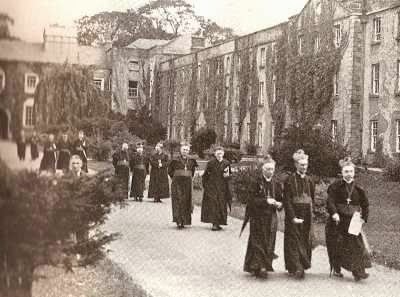
I spend each day's bus ride listening to old recordings from the archives of Irish national radio, including interviews from the 1950s, 60s and 70s. They are voices from a different world, when many Irish did not have electricity or cars, and local culture remained strong. So did the Catholic Church, and according to elders here, priests, nuns and monks were much more common sights, and much more identifiable.

Yesterday I listened, over and over, to interviews with Domincan brothers and other scholars in 1974, discussing the 700th anniversary of the death of Thomas Aquinas, and found myself fascinated by the depth of their knowledge and passion. The men whose voices I heard, as though sitting beside me, went to their graves long ago, as did most of the nuns I knew as a child. The world they represented -- almost two thousand years of scholarship and scholasticism, cloisters and sanctuaries, have almost disappeared now, and few people remember they existed, or why they had value.

As baffling as this sounds to most people, we need a world of monasteries again. We need a world of people who approach the Divine with modesty rather than flamboyance, who can live self-sufficiently even when the dominant culture collapses, who can practice self-control in all things, who believe in preserving the best of human knowledge for later generations.

"Aquinas begins by discussing how we can talk about God, and demonstrates that in a sense we can’t, because we’re trapped in our language and experience. The very structure of our language presupposes that we are dealing with our human experience and limits; our grammar and vocabulary walls our world. 

Aquinas said that we should take the words as far as we can, and only when the words break are we led to the mystery. He famously said on his deathbed that all his words were like straw. But he understood that, and wanted to make the best straw a human could.
 

Few people remember what scholasticism was, but Aquinas saw it was vital in retaining human dignity. To Aquinas, the fact that we can logically demonstrate that we have something hidden in our being, something beyond all reason but essentially human, whether we are talking about a baby or an aged person, is what allows us to act as moral beings. It keeps us from being monsters. It is what allowed us to be capex infiniti – beings of unlimited horizons."

-- paraphrased from Dominican friar Herbert McCabe of Oxford University, interviewed 1974. 

Tuesday, 7 January 2014

New Mother Earth News column

My latest piece, "Preserving Vitamins Through the Lean Months," is appearing in Mother Earth News here. Check it out.

Wednesday, 25 December 2013

Christmas as it used to be


Before Christmas we trimmed all the manes and tails of the ponies, and would stuff the hair into pillows or saddles.  Around Christmas time the excitement began; on first good day in December white-washing was underway. Pictures from old calendars decorated the walls, or tin candy lids. 

-- Dursie Leonard, Burren, County Clare, 1920s.

We were as good as gold the week before Christmas because we were told that “Holly Pux,” Santa’s friend, would be sitting on the chimney. 

-- Phyllis McDermot, Longwoods, County Meath, 1930s.

The shopkeepers had to look after their customers; everybody got some gift. Good ones got a brack and a red 1 lb. candle, others got just a brack, another just a red candle and so on. The men who got tobacco were taken very quietly down to the parlour or a glass of whiskey. It all added to the excitement.”

They bored a hole in a mangold to hold the candle, and everyone in the family was there Christmas Eve for the lighting of the candle. Christmas Eve was a fast day, with no meat; we had salted fish and potatoes, white sauce and butter, followed by tea and fruit cake. Santa only gave them perhaps an orange, a few little books, crayons and sweets, but the important thing was that Santa had come. 

-- Aine Aherne, Nohoba, Kinsale, County Cork, 1920s

A week before Christmas my father killed three turkeys and a goose. He nailed pieces of wood together to make a box, and put the turkeys in it feathers and all. Then he put an address on the box and posted it to family in Dublin. In return we got brack and a huge cake the size of a motor car wheel. 

Consiglio Murphy, Clonpriest, Youghal, County Cork, 1920s

Christmas used to be very different than it is now; if my parents had what we spend on toys they would have been rich indeed. A few days before the grocery boy arrived with the dray (cart) and a Christmas box, the ingredients for cake and pudding with a large candle in the middle.

Annie Dunne, Rathcoole, County Dublin, 1920s. 
 
On Christmas Day, if the weather were fine we went for a walk before dinner. Our relations came to visit, and we played musical chairs with our cousins while someone played the piano.

We played tops, which you kept spinning with a little whip; hoops, which were old bicycle tires without spokes which you rolled along the road with a small stick; marbles, which were divided into large ones (taws) and small ones (mebs), and conkers. 

-- Gerry Fehily, Donnybrook Village, County Dublin, 1920s

The house was scrubbed before Christmas, the roof thatched and the outside whitewashed. The lining of the chimney was cleaned lest Santa be blackened, even though he rarely bought more than oranges and sweets.

The goose was plucked and killed beforehand, and left ready for cooking.

Christmas Eve was a fast day, but at 3 am we rose, dressed in Sunday best, and making our way by the reflection of the sea and the moon, we rowed our boat to the mainland and walked the remaining three miles to church. We stayed on for the three Masses Christmas morning, so joyous was the carolling and heavenly was the organ playing. 

-- Ann McGuire, County Galway, 1930s

From No Shoes in Summer, a compilation of interviews from Irish elders in the 1930s.

Saturday, 21 December 2013

The one-year anniversary of Nothing Happened Day

Three hundred and sixty-five days ago, millions of people felt a growing sense of -- I was going to write “relief,” but it might have been “disappointment” -- when the world didn't end on Fake Mayan Prophecy Day. Social media users around the world greeted the non-event with the kind of viral mockery everyone loves these days, so long as it’s someone else’s beliefs being mocked.

Such scares, however, can be serious business; a few weeks before the predicted end of the world, Britain’s Telegraph newspaper reported that “panic buying of candles and essentials has been reported in China and Russia, along with an explosion in sales of survival shelters in America. In France believers were preparing to converge on a mountain where they believe aliens will rescue them.”

China might seem a strange place for the apocalypse idea to crop up, but the Telegraph said that “In China … a wave of paranoia about the apocalypse can be traced to the 2009 Hollywood blockbuster ‘2012.’ The film … was a smash hit in China, as viewers were seduced by a plot that saw the Chinese military building arks to save humanity.”

That $200 million steaming pile of callous manipulation, I suspect, did a great deal to boost the 2012 myth from New Age circles into the mainstream. As I wrote a couple of years ago, we might be able to forgive filmmakers for creating an overpriced package of ridiculous escapism like The Core or Volcano. Unlike those films, however, and like the fundamentalist Left Behind series, the film implied their fictional work presaged actual and imminent tragedies.

The filmmakers also dropped the “Rapture” name for extra points among the mega-church crowd, both in the script and in the cruel advertising line, “Will You Be Left Behind?” The difference is that the Left Behind authors seem to truly believe their dubious theology, whereas the filmmakers seemed to be exploiting the genuine fears of real people to make some quick cash.

Even if only one person in ten thousand takes them seriously, scares like the 2012 fakery can cost real people their lives. David Morrison, an astronomer at NASA, told the Telegraph that “at least once a week I get a message from a young person, as young as 11, who says they are ill and/or contemplating suicide because of the coming doomsday. I think it’s evil for people to propagate rumours on the internet to frighten children.”

Apocalyptic scares have cropped up throughout history, and no one has written a more readable overview of them than John Michael Greer. His drily funny book Apocalypse Not: Everything You Know About 2012, Nostradamus and the Rapture is Wrong probably saw sales fall off after Nothing Happened Day, but should still be read as immunisation against the next one.  

One area Greer could have explored more, perhaps, was “Why Mayans?” Why not prophecies from Norwegians, or Saudis, or any other group? The answer seems to be twofold; first, it’s easier to project any beliefs or ideology you like on a now-extinct group that can’t protest. There are some descendants of the Mayans left, who have rightly objected to their pop-culture co-opting, but poor Third-Worlders do not generally have the media influence of California New Age gurus.

The other reason has to do with the exalted place Native Americans hold in popular culture. Of course Native Americans were the victims of the greatest human genocide in history, and even into the mid-20th century were portrayed in popular fiction as villainous savages. The response of the Sixties counterculture, though, was insulting in a different direction, projecting onto Native tribes whatever ancient wisdom they wanted to hear. This was done mainly through the use of Italians and other Europeans pretending to be Natives, making up New Age teachings and passing them off as authentic.

As John Miller wrote in the National Review, “Between 1960 and 2000, the number of Americans claiming Indian ancestry on their census forms jumped by a factor of six. Neither birth-rates nor counting methodologies can account for this explosive growth. Instead, the phenomenon arises in large part from the increasingly idealistic place Indians occupy in the popular imagination. Much of it is based on harmless sentiment mixed into a hash of unverifiable family legends and wishful thinking among folks who hang dream-catchers from their rear-view mirrors. But for a distinct subset, it’s all about personal profit. They’re professional imposters who have built entire careers by putting the sham into shaman.”

In some cases people just claim to be Native when they are not: author and provocateur Ward Churchill, actor “Iron Eyes” Cody, and many others. In others Europeans claim special insight into Native culture: Carlos Castaneda, for example, wrote his entire Don Juan series with supposed interviews based on a reclusive Yaqui Indian no one else ever met, while Lynn Andrews did something similar with her Medicine Woman series. The Celestine Prophecy, Mutant Message from Down Under -- for a while it seemed every year brought more books from dead or remote peoples, offering life-coaching for upscale Westerners.

Some of these teachings are useful in their own right; Canadian ecologist “Grey Owl” married into Native American communities and wrote beautifully about protecting wilderness, even if he was originally an Englishman named Archie Blayney. “The Education of Little Tree” is a lovely story, even if it turned out to be fiction written by a white segregationist.

Decades of such romanticising, though, means that followers of the Sixties counterculture treat Native teachings with a special reverence – even fake ones, and they usually are. I know a number of people who sneered at Harold Camping’s numerous Rapture predictions who seemed to take the Mayan claims seriously – at least, as seriously as anyone takes anything these days, forwarding memes while filtering any convictions through layers of post-hip meta-irony.

The 2012 books I leafed through also yanked science-sounding terms into the discussion whenever possible, describing a “quantum leap” forward in human “evolutionary levels.” Basically, it’s the same technique used by the religious cult “scientology,” stealing bits of words from actual scientific research and using them to imbue their vague hokum with a bogus legitimacy.

Many people I talk to seem unconcerned with doomsday crazes, considering them throwbacks to an earlier age of superstition, which will die out eventually. It’s been a standard line of science and science fiction for a hundred years, recited in everything from H.G. Wells’ Things to Come to the Star Trek series, that technology would allow humans to outgrow primitive ideas. Instead, however, the opposite has happened -- as people spent more of their hours staring at electronic media, they became more susceptible to superstition, for several reasons.

First of all, news and fake news travel instantly around the world, and are increasingly difficult to escape. A year ago today, I was listening to neighbours talk about the alleged Mayan prophecy … at our local pub in rural Ireland. Locals would have been sitting at the same pub fifty or a hundred years ago -- several apocalypse scares ago -- but would not have easily known about them; until a few decades ago, few places in Ireland had electricity or modern media. Today, though, people here hear the same celebrity gossip, and watch the same blockbusters and visit some of the same internet sites as people everywhere. Instead of a dubious notion having to infect a critical mass of people in a town before spreading to the next town, a con or conspiracy theory can appear everywhere in the world – to a teenager in Saskatchewan, an old lady in Turkmenistan and an Irish farmer – simultaneously.

The modern world has made us more susceptible to superstition in other ways; when we spend most of our time staring at glowing rectangles rather than living in the real world, it becomes easy to become isolated, paranoid, or trapped in a misinformed bubble of like-minded people. Also, when we spend most of our time moving pixels on a screen for a paycheque, it becomes all the easier to fantasise about fighting zombies or some other more hands-on existence.

Finally, the very nature of our online lives means that information flits in and out of our minds quickly, leading us to forget, only a year later, that there were millions of people who genuinely thought the world would end. It leaves us singularly unprepared for the next fake Apocalypse, whose rumours are already circulating somewhere.

You might think that people are right to be alarmed, even if it takes a fake Mayan thing to alarm them. Between fossil fuels and climate change, an increasingly fragile economy and a disintegrating culture, humanity faces all kinds of problems. I’ve been writing about them for years; is it hypocritical of me, you might ask, to criticise someone else’s doomsday theory?

But here’s the thing: peak oil was never the apocalypse. When the theory of peak oil was revived around the turn of the millennium, some well-intentioned and otherwise beneficial thinkers saw in it the doomsday they had been waiting for. Ten years ago, however, when I wrote my first magazine cover story on peak oil, I said that we “won’t wake up Amish one day,” and when conventional oil peaked a few years ago, we didn’t. Rather, the promising peak oil movement dissipated somewhat after that, perhaps because the countdown had ended and the world had not collapsed. Framing peak oil as the apocalypse harmed the movement’s credibility, and undermined the very useful contributions of volunteers in local communities around the world. 
 
Climate change is also not the apocalypse, in that sense. Almost all scientists agree that humans are causing climate change at a geologically alarming pace, but on a human scale the change is slow and scattershot enough to leave many non-scientists unconvinced. Even when events do happen – this or that city being devastated, a record-breaking summer, droughts and floods like no one has ever seen – no one can prove that climate change caused it, and with our short modern memories we quickly move on. Claiming that “we have only ten years left” to stop climate change, as some activists have done for decades, only discredits climate science in the eyes of the public when, ten years later, the changes have been small or quickly forgotten.  

None of these crises in our culture, our economy, or in the living world constitute the Apocalypse of John of Patmos, or any of the rest of the Antilegomena. They are not the Big One people have been waiting for, and people need to stop waiting. None of them will wipe out everyone you don’t like, and leave them sorry they doubted you. None of them will eliminate all those other humans standing in front of you in the grocery queue, leaving you with all their stuff.

I do expect a great many crises in the years to come – more weather disasters, economic crashes, wars and rumours of wars. I expect that actions that were once considered unspeakable might become commonplace, just as actions fifty or a hundred years ago are unthinkable to us, and vice versa. Preparing for such long-term events, though, means working with others, making your little corner of the world more resilient in the face of change, and adhering to a consistent set of principles even when the culture shifts tectonically under your feet. It means changing your life in a thousand small and tangible ways.

At some point, of course, the world will end – for you. That sobering realisation – in Greek, Apocalypsi, or Revelation – is what most apocalyptic scriptures are really about; the commonly cited passages about the end of the world take on a very different meaning when you posit that they are not talking about a universal end, but a personal one. That’s what most religions are about: When done rightly, they help you spend your remaining years meaningfully, to think of others before yourself, to set an example the world can see, and to bring you closer to God.

Doomsday thinking, as in the Mayan 2012 belief, does the opposite. It encourages people to retreat into a bubble of believers. It discourages people from making small improvements, when everything is about to be swept away. It makes people passive in the face of predestination. It tells people that God will come to them, and they don’t need to do anything.