Friday, 30 August 2013
Published at the Daily Prepper
Sorry our return to blogging has been slow -- I'm working on it. In the meantime, the Daily Prepper has run one of my articles, on the stone walls of Ireland. Check it out.


Saturday, 24 August 2013
Putting yards to use

Take a few facts from recent news reports and try to put them together:
1.) There are about two million homes in Ireland, according to the Central Statistics Office -- most, presumably, with front and back gardens, some near expanses of unused fields. Of these, 289,451 – 14.5 per cent of all homes here – lie vacant.
2.) Four hundred and twenty-seven thousand people are unemployed in Ireland, also about 14 per cent of the country. Five-and-a-half thousand Irish people are homeless, according to the Department for the Environment. Most, presumably, have little to do.
3.) Most of the food eaten in Ireland must be imported from outside the country, according to the Sustainability Institute.
These are no excuses for these facts to co-exist. It’s understandable if not all homeless can be put into currently vacant houses – homeless people can have many issues. But those houses have open space around them, room for gardens that could grow enough food for everyone in the area.
Ireland’s prodigious rainfall and long growing season create a paradise for agriculture, and we know that we can grow and make most of their own food and belongings, because for hundreds of years we did. Meanwhile, we spend money importing food from across oceans, food bred and grown to survive the journey rather than for taste or nutrition.
Instead of gardens, all those homes have grass around them, which someone – presumably the owners of the estate – must pay to mow. Meanwhile, animals that could eat that grass stay in the surrounding fields, while their owners must pay for hay to keep them over winter. Some homeowners use chemicals on their lawn to fertilise the soil; meanwhile, they must find a way to get rid of their animal waste.
Other articles recently talked about the problem of elderly people living alone, with no one to talk to. These are people who grew up with the traditional self-sufficient crafts that got their families through hard times, yet now that times are getting harder again, younger people lack the knowledge to cope with hardship.
In other words, we have inherited several problems that fit together like pieces of a jigsaw to create a solution, and, year after year, choose to deal with them as separate problems. There are many ways of sharing land, but they all involve bringing together people who have time – say, unemployed, under-employed, homeless, children and pensioners – together with land that can provide food for the community with an investment of time and effort.
In a fairly ambitious form of the plan, local organisations like city and county governments, sports clubs, churches and charities could decide to devote it to growing food for the hungry, and hires homeless or unemployed men to work the property. Alternately, they could loan the land out as allotments, to allow such people to grow their own food. The young men would learn vital skills, gain experience and avoid the trouble that comes from adolescents with too much time.
In the UK the Landshare Project has brought more than 72,000 such people together, in a country where tens of thousands of people have applied for community garden space and are waiting in queue. In one area of Manchester, where unused land has been turned into a community allotment, police reported a more than 50-percent decrease in anti-social behaviour, according to UK news sites – they believed it gave young people something to do.
A project like this does not have to be limited to estate gardens. Our area has many green fields that seem little-used, and could be put to work. It doesn’t have to be for growing allotments, either – local residents could use an overgrown vacant lot to graze goats, or plant young fruit and nut trees across green fields. To see if this kind of project would work where you are, walk around your area and ask these questions: how much of the land is unused? Are there unemployed or elderly people around with nothing useful to do? Are there people who don’t like spending money, or who like eating food?
See if you can find them. Take up the challenge.
Number of homes: http://www.cso.ie/px/pxeirestat/Statire/SelectVarVal/Define.asp?maintable=CDP07 Unemployment rate: http://www.irishtimes.com/business/economy/ireland/unemployment-rate-remains-at-14-1.1378898
http://www.landshare.net/community/
Tuesday, 20 August 2013
Transportation

"Most people had a pony or donkey, but young people walked. The only motor car in the area was owned by the solicitor, and he drove it to see people who were making out their will, and once people heard the motor-car, they started talking about the person as though he were dead already.
There were two motorbikes in our area, one owned by the priest, and the other owned by the doctor -- and when they passed late at night, we knew by the sound of the bike which one it was passing. As soon as they heard it in the distance, people were in a panic as to
who was badly off."
-- Recollections of Aine Aherne, of Nohoba Kinsale, County Cork, of growing up there in the 1920s. Photo of my neighbour driving his pride.
Thursday, 15 August 2013
Selling laces

RTE radio documentary on village life, "Up the Church," broadcast 1972.
Photo courtesy of Irishhistorylinks.com.
Saturday, 10 August 2013
The future of buses

Only twenty or thirty years ago, public transportation was basically the only transportation for many Irish, as so few people could afford cars – and now that the nation's economy crashed and had to be bailed out a couple of years ago, it has become many people’s only form of transportation again. Yet if governments become increasingly cash-strapped, they will be less able to buy new buses or replacement parts, much less restore some of Ireland’s once-extensive rail lines. More and more people will need to use the bus, yet the bus might be less frequent and more expensive.
There is another solution, however: during the Celtic Tiger a few wealthy Irish bought SUVs, vans or Hummers for some reason, apparently to seem more like Americans. Such suburban assault vehicles are dubious in the USA, but at least there most people are assured of being able to get them on the road; on Irish roads, which are the approximate width of American supermarket aisles, they look ridiculous. A few of them can function on the Irish landscape, for the few other large vehicles can swerve out of the way delicately, as they do with buses -- but roads filled with them on both sides would be disastrous.
Moreover, they receive only half the mileage of 1920 Model Ts, and are not generally used for fording rapids or scaling Alaskan mountains, as in telly adverts, but rather for inching in and out of parking spaces. These vehicles typically have enough room for at least six people, plus enough cargo space, as writer Dave Barry put it, “to pick up something else, such as a herd of bison.” Between the spike in fuel prices a few years ago and the recession today, many SUV owners are trying to rid themselves of these white elephants; look in any Buy-and-Sell section of any newspaper and you will see such vehicles for sale, at plummeting prices.
These two problems could solve each other. the infamous mileage of SUVs and Hummers only results from the empty space in the back; fill it up with passengers and it becomes a very green choice. Local officials could buy them cheaply, or rent them to use to ferry passengers in lieu of bus lines.
Passengers might be the most under-appreciated factor in how much fuel and money you waste. As I write this, for example, a business headline boasts of Toyota’s multi-million-dollar plan to boost fuel efficiency by 25 percent – but any of us can boost the efficiency of our cars by several hundred percent instantly, with no additional expense or technology, simply by getting more people in the car.
If neither the city government nor the populace has money, enterprising officials could make more creative arrangements – say, giving the SUV owner use of a foreclosed property in exchange for the use of the vehicle, rather than forcing the homeless owner to sleep in it. They could agree to co-sign a residents’ mortgage in exchange for permission to use the vehicle.
SUVs have several advantages over regular buses; for one thing, they would be more comfortable. Their ability to handle rough terrain might turn out a blessing after all, as they can continue to drive over roads in disrepair -- as our roads might increasingly be. More importantly, since they only take eight or nine passengers at a time, they can be economical in small towns and in the country, driving routes that cannot afford 80-seat buses. Bus routes could actually be expanded in places, allowing otherwise marooned residents easy access to jobs, hospitals and food markets.
They can also vary their routes slightly to pick up passengers at home or a short walk away if needed, responding to phone calls for assistance. If a country-dweller needs to get to town and has the SUV driver’s mobile number, for example, they could ask the driver to vary their route slightly rather than walking miles to the nearest pickup point, without unduly inconveniencing other waiting passengers – an important detail for elderly and the handicapped.
Cash-strapped cities could also require drivers to supply their own SUV and fuel, compensating them by letting them keep riders’ fares, and freeing the local government from financial burden. If this sounds suspiciously like a taxi, it is – just a taxi that runs regular routes. Put another way, it could combine the security of bus lines with the flexibility of taxis and the social advantages of carpooling.
The modern system of everyone having their own personal high-speed vehicle will turn out to be a brief and bizarre moment in history, but people will still need to travel. Too many local people, though, think only of their own situation – not realising that thousands of others are in the same boat and that, together, they could do something about it.
Photo: A double-decker bus and horse carriage in downtown Dublin. Parts of this article were published previously in 2009. Originally published in the Kildare Nationalist newspaper.
Wednesday, 7 August 2013
Trams at Terenure
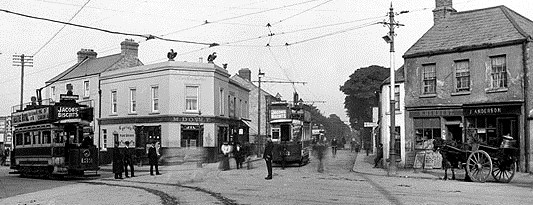
Streetcars seem slow to modern eyes only because we compare them to a car on the motorway; compare them to a car in the city and they may have been faster. One of the Dublin lines ran out to the suburb of Lucan a hundred years ago, and passed through town at 25 miles an hour -- a goodly speed in Lucan's modern traffic jams.
Wednesday, 19 June 2013
Footing turf

Turf, also called peat, is the remains of centuries of moss and other vegetation that built up in the bogs, which built up over the millennia when the submerged lower strata did not fully decompose. Draining the bog and pulling back the top layer of vegetation reveals black and spongy bio-mass that turns reddish-brown and hard when it dries, and creates a slow-burning, smoky fire when lit.
For hundreds – probably thousands – of years it has been the main way people in this cold country kept warm. The smell of burning turf is one of the most distinctive things about this land, and in country homes and pubs alike here neighbours gather around turf fires in the winter evenings.
Most farmers who lived anywhere near a bog had a ready source of fuel for the winter, once they pulled away the top layer of vegetation and exposed the peat underneath. Farmers here – everyone was a farmer of course, whatever else they did – carried special shovels shaped like one corner of a square, made for sinking into sides of a ditch and scooping out long rectangles of peat.
Today a walk through bog less than a kilometre from our house reveals fields of flowers, never-cut or grown-over, as well as ditches used to drain away the groundwater, and finally a maroon peat landscape, with the underfoot consistency of a firm mattress.
It has become a decidedly uneven landscape by now, with hollows a few metres deep in the red land, quarried where generations have scooped out the turf, interrupting it on its way to becoming coal. The canals in front of our house were built in the 1700s to go through this area, with railway tracks running from the canal banks deep into the bog-lands. Spanning the canal sits a rusted trestle and crane, about three metres tall, and perpendicular to the canal, heading off into the bog, are rail lines now buried under grass.

Burning turf makes a strange conundrum for fans of independent, sustainable living. On one hand it is the only fuel, apart from wood, that you can gather yourself near your home, using ordinary tools. Peat bogs around the world present an opportunity for people to keep warm in winter without being dependent on the grid, unless governments clamp down on the activity or the bogs are tapped out.
On the other hand, “while peat is classified by the IPCC as a renewable fuel,” wrote Kris De Decker in Low-Tech Magazine, this is highly debatable. Peat is renewed at a rate of about one millimetre per year at most, and so it takes about 3,000 years for a peat layer of three metres to return to its original size – and only if the land is not disturbed in that time. In addition, mining the peat has a very large impact on the landscape, as we shall see, while the burning of turf produces slightly more CO2 emissions than coal for the same energy content. The only advantage it has over coal is that it produces less smoke and has a lower sulphur content, and thus produces less air pollution than coal.”
Right now the Irish government is forbidding hand-harvesting of turf, one bog at a time, ostensibly to protect it as a wetland -- which sounds good, except that the national energy company already mines the boglands on an industrial scale to produce most of the country's electricity. In the meantime, my daughter and I dried enough to last us for the next few years, by which time this old tradition might be only a memory, or performed in secret.

Top photo: Loading turf into a boat for transport, circa 1900.
Middle photo: Cut turf and stacks of footed turf.
Bottom photo: My daugher climbing one of the quarries in the bog.
Wednesday, 12 June 2013
The Train to the World

"People, they don't realise what they lost," said Dan, an old man who remembered the Bundoran Express, the train that carried families to the sea and pligrims to Lough Derg. "People were so happy then."
"Back then, going to the seaside would be like kids going to America today," said Selwyn Johnson of Eniskillen. "Just to get to the seaside was a very special event."
"The other thing about a railway station like Eniskillen -- it was the last place people would say goodbye before leaving the country," Johnson said. "It was the place they made before going on honeymoon, or to war, to make a life elsewhere."
-- From the RTE radio documentary "The Bundoran Express," broadcast 04 August 2010.
Tuesday, 11 June 2013
Keeping food

Around us, for example, hawthorns bear shoots for a few weeks in spring, sorrel emerges in the summer, and berries appear for a few weeks in autumn – but none of those provides a great deal of nutrition, and a diet of just a few species of plants in any week would grow quite monotonous. Then, of course, there are long months of winter where little grows, and if you get a year like we had in 2012, you get the equivalent of eighteen months of winter. And Ireland, of course, has one of the most temperate of climates; most regions of the world dry up, freeze, bake, swelter or flood for long stretches of the year.
If you are like many animals, the lean times are simply when you live or die, and your numbers reduce. Humans, on the other hand, came up with ways to preserve the harvest through the lean months, through generations of trial and error, allowing us to spread to almost every climate in the world.
The specific methods changed with culture and climate, but people knew how to dry, pickle, salt, bury, smoke and ferment, just as people used to know how to raise food, build shelters, birth babies, raise children and bury their dead. It is only in the last couple of generations, here in the West, that we have forgotten all these things, and expect to be taken care of.
Today, a shocking percentage of people -- a majority in America - don't cook at all. Seventy per cent of Americans are overweight, and a recent poll in England found that a third of food was thrown away uneaten. That constant stream of cheap and unhealthy food, though, depends entirely on a flood of fossil fuels, a stable climate, a healthy economy and many other factors that will fade as the years pass. More and more modern people are taking up backyard gardens, allotments and other ways of growing food, but these hobbies will be of only limited value unless they also relearn to stretch most of the harvest into the rest of the year.
Preserving food against decay generally follows a simple principle: make it unpalatable for the things that would decay it, by making it too dry (dehydrating), too cold (freezing), too salty (salt pickling), too sweet (jams and cordials), too acid (vinegar pickling) or sterilised and removed from oxygen (canning).
Drying food is such a commonplace technique that it has become invisible to us; say “dehydrated” and most people think of Army rations, but of course our flour, corn, rice, barley, oats, beans, tea, coffee, herbs and spices all sit dried in our kitchens, and begin to go bad if touched by moisture. Most of us could not dry grains at home, or would need to, but you can certainly dry herbs from your garden; we hang our sage, rosemary and oregano upside-down in the kitchen pantry, along with nettles (for tea) and onions from the garden.
All manner of edible plants, moreover, can be dried for teas – dandelions, mint, clover, bramble shoots, nettle, chamomile, Echinacea, fennel, dill, anise, thyme, linden or St. John’s Wort. Fruit of all kinds can be dried: raisins, sultanas, sun-dried tomatoes (technically a fruit), apple rings, fruit rolls and any number of processed foods. Some of these tend to come from warmer climates and can be shipped here; raisins were a commonplace ingredient in Irish dishes for generations, a precious bit of fruit during the dark months, but native dried fruit could have done as well.
Drying meat into jerky is an old method of storing protein, and other people dehydrate chopped vegetables as soup starters. The Japanese dry seaweed to use in soups, and we here in Ireland pay high prices for it at sushi restaurants, yet ignore the thousands of tonnes of edible seaweed on our own shores.
Of course, the most familiar kind of indefinite food storage for many people is freezing, which still requires electricity but is a good place to start. Rather than eating out, ordering in or making individual meals one by one, you can make a large quantity of a dish in season and freeze it in a dozen meal-sized portions for later. It costs much less than making many individual meals, you can mix-and-match dishes, and the food retains most of its vitamins and flavour from the time it was picked.
Your climate will make some kinds of preservation easier or more difficult -- our damp climate in Ireland means we have to watch out for mould when drying, and you may need the help of your radiator or oven. On the other hand, we have very little snow or even frost here, and this is a good climate to simply leave things like parsnips, celeriac or other root vegetables in the ground through the winter, and yank them out as you need them. Some people put straw or bags over them to protect from frost, or pull them from the earth and store them in sand.
Finally, you can preserve some foods by changing them into other foods; we turn our milk into yogurt and soft cheese, and my first hard cheese experiment created some very nice Parmesan. More on how to make cheese soon.
Wednesday, 5 June 2013
Clerical vote

We think of the local priest as a man of great power in
local villages, in rural Ireland and elsewhere. But as Charlie Hopkins from
Arigna pointed out in a 2010 radio documentary, local congregations could vote against their priests as well. Workers in the Arigna mines had gone on strike for a five-day week, and the parish priest opposed the decision:
“An old priest in Arigna went against the strike and held
what was termed at the time a housewives ballot, preached from the altar what was called a
‘housewives’ ballot,’ that if the men didn’t go back to work the women
shouldn’t cook their dinner. So the ballot was issued to the women of the church
and it was returned to him, and after he counted the results the ballot was
burned, and never called out, so we guess it must have gone the other way.”
“That was the end for that priest, because when next he
tried to raise money for the church, he got no response, and the bishop moved
him on.”
Photo: A priest blessing a garda, or policeman.
Subscribe to:
Posts (Atom)